Shake it till you make it!
On Vibration, Memory, and the Body's Oldest Language
Madalina Yoga Alliance E-RYT 500
On Vibration, Memory, and the Body’s Oldest Language
यस्योन्मेषनिमेषाभ्यां जगतः प्रलयोदयौ
By whose opening and closing of the eyes the universe dissolves and arises again.
— Spanda Kārikā
Today, an article in The New York Times caught me off guard, it was about a celebration of something almost embarrassingly simple: jumping on a mini-trampoline.
The piece summarized a growing body of research showing that rhythmic bouncing improves cardiovascular health, balance, coordination, and nervous-system regulation, all while sparing the joints the impact of more conventional exercise or running. It was fascinating. It was also, strangely, familiar and it opened up a door to my imagination.
Because as I read it, one sentence kept forming itself beneath the science:
We are not discovering anything. We are not inventing the wheel. We are just reaching to a fundamental truth.
Modern science has an extraordinary capacity to measure. It can quantify heart-rate variability, bone density, lymphatic flow, hormonal cascades, neural firing patterns. It can tell us, with real precision, how something works or not. What it rarely tells us is that we have been doing this — this simple, rhythmic shaking of the body — for as long as we have been human….from an anthropologic point of view we are all Shakers.
❖
Long before physiologists began studying rhythmic movement, people were already shaking.
They shook in celebration, wedding, solstices, seasons....
They shook in mourning, in the loss of a dear one.
They shook around fires ,under the moon, before battle, after victory.
They shook during initiation. They shook to enter trance. They shook to pray.the shook to search for the god within.
They shook because movement was never merely movement. It was a technology of consciousness — a way of discharging what the nervous system could not yet name, a way of metabolizing grief and fear and ecstasy long before anyone had a word for “trauma,” or for “regulation.” The body knew unconsciously what the vocabulary would take millennia to catch up to.
Today something curious is happening. Psychologists, neuroscientists, and trauma therapists are rediscovering, almost sentence by sentence, what older cultures never forgot. Dance Movement Therapy has entered hospitals and clinical settings. Trauma therapists increasingly invite patients to move before they ask them to speak, trusting the body to carry what language cannot yet hold — an intuition not far from what polyvagal theory now describes in the language of the vagus nerve: that rhythm and motion can return an overwhelmed nervous system to safety faster than any sentence can. The thud, thud of techno music leaves no space for bad thoughts. Or ant thinking at all… They say routine is good for mental health, and techno is nothing if not routine. Psychoanalysts recommend techno festivals as a way to improve our overall wellness.
Ecstatic dance communities keep growing across Europe and the worlsd.In cities like Berlin, thousands of young adults gather weekly — not in search of intoxication, but of presence. No choreography. No performance. No alcohol. Only music, movement, and permission to inhabit a body again.
For decades, Osho proposed something that initially sounded almost paradoxical: before asking people to meditate, he asked them to move.
His Dynamic Meditation begins in vigorous breath and catharsis. His Kundalini Meditation opens with fifteen minutes of shaking, before the body is allowed to dance, then sit, then finally rest in silence. It reverses the order most of us were taught — instead of forcing stillness onto an agitated body, movement becomes the doorway to silence. Shaking is a natural mechanism of release. Wild animals shake after escaping danger. Humans often suppress this instinct because we are taught to remain composed. The body stores tension that the mind never finishes processing or understanding.
The purpose of shaking is to stop controlling. Rather than making the body shake, you allow the shake to emerge from within. Little by little, muscular contractions soften, habitual patterns dissolve, and energy begins to flow more freely. It is as if the body is dusting itself off from old experiences.
From the tantric perspectives: Shaking awakens dormant life force (Shakti). As the body loosens, prana can move through the nāḍīs with fewer restrictions and the Kundalini serpent energy can flow to meet the Shiva Consciousness principle.
Perhaps the body needs to complete a conversation before the mind can become quiet. The shaking is an act of creation and destruction at the same time.
Ayurveda, the ancient Indian medicine would probably not be surprised by any of this.
Health, in the classical Ayurvedic understanding, is never static. Digestion transforms. Breath moves. Blood circulates. The heart contracts and expands. Thoughts arise and dissolve. Emotions move through the organism. Life expresses itself through continuous flow.
Disease begins where movement is disturbed. Channels become obstructed. Ama(the toxins which are styagnant) accumulates. The organism gradually loses its capacity to transform. Healing, then, is not always about adding something. Sometimes healing begins the moment something starts moving again, letting go of the stagnation and entering the flow of life. Th e disease is a symptom that our inner fire weakens and stops burning the dead cells and useless ones, shaking brings back the fire of life back into the game.
The more I sit with this, the more I suspect movement is not simply one characteristic of life among many. Movement may be its defining quality.
Cells divide.The heart beats.The lungs expand.eurons fire across the dark.The fascia continuously reorganises itself.Our cells die and get reborn every second .
Even what appears perfectly still vibrates beyond the reach of our perception. Stillness, perhaps, is not the absence of movement — it is movement in perfect balance. The moment movement ceases completely; we no longer call it life.
Every traveller knows that motion changes the perception of time. Every dancer knows that rhythm alters consciousness. Every meditator knows that a single hour can dissolve without effort.
Physics reminds us that space and time are not independent realities, but two dimensions of the same fabric. This is a very different domain from the one I usually write in, and yet I cannot help wondering whether our subjective experience recognizes something of that same intimacy. Movement changes the way we inhabit space. It changes the way we experience time. More profoundly, it changes the way we experience ourselves and the world.
Indian philosophy takes this intuition a step further: reality itself is movement.
Shiva, as Nataraja, the Lord of the Dance, is not simply depicted dancing. His dance is creation. His dance is destruction. His dance is transformation — the three held in a single, continuous gesture.
Galaxies spin. Oceans rise and fall. Leaves tremble in wind. Breath enters and leaves the lungs. Everything participates in the same cosmic rhythm — the same spanda, the subtle pulse that Kashmir Shaivism holds as the heartbeat of consciousness itself, endlessly contracting and expanding, endlessly becoming world. As the art historian Ananda Coomaraswamy beautifully wrote:
“The dance of Shiva is the dancing universe; the ceaseless flow of energy goes through an astonishing variety of patterns.” can yoiu gove me the story of nataraja
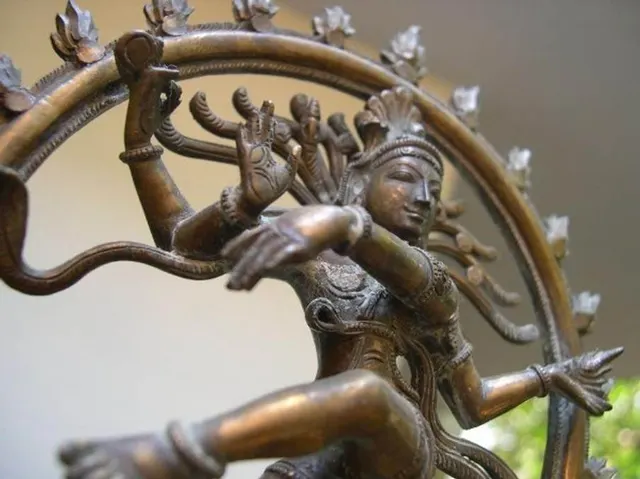
The story of Nataraja (नटराज) means “The King of Dance“ (Naṭa = dancer, Rāja = king). It is one of the most profound symbols in Hindu philosophy because it is not merely a story about Shiva dancing—it is a vision of how the entire universe exists.The most beloved legend takes place in the Daruka Forest.
Long ago, a group of powerful sages lived in this sacred forest. They had mastered rituals, sacrifices, and scriptures. Over time, however, they became convinced that their rituals themselves controlled the universe. They forgot that knowledge without humility becomes ego.Shiva decided to teach them a lesson.He entered the forest disguised as a beautiful wandering ascetic, while Vishnu accompanied him in the enchanting form of Mohini. The sages and their wives became fascinated. Their certainty cracked, and their pride turned into anger.Believing they could destroy this mysterious ascetic through ritual power, the sages summoned terrifying forces.First, they created a tiger to attack him.Shiva smiled, killed the tiger effortlessly, and wrapped its skin around his waist. Even today, Nataraja is often shown wearing the tiger skin, symbolizing victory over instinctual aggression and untamed desire.The sages then released a venomous serpent.
Shiva simply lifted the snake and placed it around his neck as an ornament. What was meant to be poison became an expression of awakened energy and mastery over fear.
Finally, they invoked a terrible dwarf demon named Apasmara.
Apasmara represents something deeper than evil. His name literally means forgetfulness or loss of memory—not ordinary memory, but the forgetting of our true nature. He is ignorance (avidyā), spiritual unconsciousness, the illusion that we are separate from the whole. Rather than killing him, Shiva placed one foot gently upon his back.This is important.Ignorance is not destroyed forever. It is held beneath awareness. If Shiva lifted his foot, ignorance would rise again. Awakening is therefore not a permanent victory but an ongoing dance. Then something extraordinary happened.Shiva began to dance.Not a dance for entertainment.The dance itself became the movement of the cosmos. Every heartbeat, every birth, every death, every expanding galaxy, every collapsing star, every inhale and exhale became part of this eternal rhythm.
This is the Ānanda Tāṇḍava—the Dance of Bliss.
We do not dance because the universe dances. We dance because we are the universe dancing.
And then my mind returns, as it often does, to one of my favorite books by Nikos Kazantzakis and the wonderful movie Zorba the Greek (1964).
In one scene of this great movie starring Anthony Queen, Zorba tells Basil — he likes him too much not to say it:” You’ve got everything except one thing: madness. A man needs a little madness, or else he never dares cut the rope and be free.”
He isn’t talking about the dance. Not yet…
The rope is cut somewhere else first — in the decision, in the willingness to risk ruin without flinching. The dance doesn’t cut it. The dance is what freedom looks like once it’s already loose. It’s what a body does when it finally has nowhere left to perform for, nothing left to protect, no failure left to prevent…the dance as an opportunity to free himself.
That’s why, on the beach, after everything has collapsed, Zorba doesn’t ask Basil to understand anything. He asks him to Dance. Not so the dancing will free him — but because freedom, once it exists, has to go somewhere, and the body is the only place large enough to hold it and express it.
“Teach me to dance.” Said Basil…
It may be one of the simplest and most profound lines in literature. Not a request for technique. A request for the one instrument capable of expressing what the mind had already decided and the body hadn’t yet been permitted to feel.
Perhaps this is where all these paths quietly meet. Neuroscience. Anthropology. Psychology. Ayurveda. Yoga. Mythology. Literature. Film. Each speaks a different language. Each, in its own dialect, points toward the same intuition: movement is not merely exercise. Movement is one of the oldest expressions of being alive…is a profonde wat to meet ourselves, half human, half creature.
We have a phrase for this, and we use it without ever noticing what it’s actually saying.
“I’ve been shaken”
We reach for it when something has cracked us open — a loss, a diagnosis, a piece of music, a face we didn’t expect to see again. We don’t say we were informed. We don’t say we understood. We say we were shaken — as if the news had reached not only our mind, emotions but our roots.
Because that is exactly what happens. To be shaken is to have something loosen at the foundation. Destruction and creation, held inside the same word, the same breath. The language knew this before philosophy ever needed to explain it.
So this was never really about a trampoline, or a dance floor, or fifteen minutes of movement before meditation.
It was about the root. About what it means to let something reach it.Also to go search for it…to get lost inside , and to ger reborn…
We are not beings who occasionally celebrate life. We are life, shaking itself awake.
A few Traditions of Shaking
Kalahari San (Southern Africa),Trance dance around the fire..purpouse: Healing, protection, communion with the spirit world
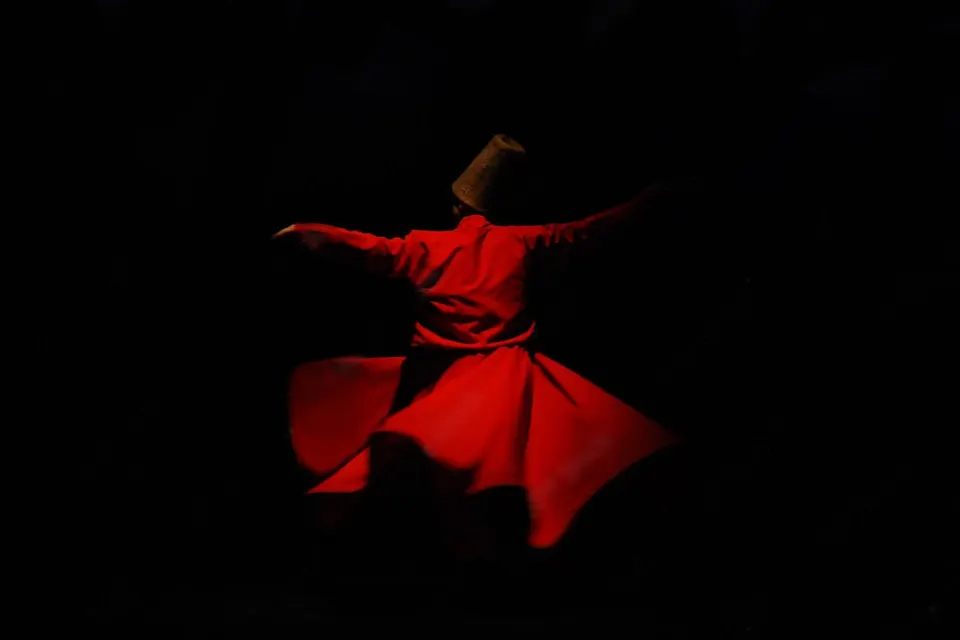
Sufi mysticism, Whirling (Samā).Goal :Dissolution of the ego, union with the Divine
Haitian Vodou,Ecstatic possession dance. Goal :Communion with the Lwa, catharsis
Pentecostal Christianity,“Holy Ghost” shaking. Goal:Spiritual surrender and release
Balinese Hinduism,Kecak and trance dance.Goal:Purification, communal trance
Osho / Neo-Tantra, Kundalini Meditation (shaking phase).Goal: Catharsis before stillness.
Contemporary somatics,Trauma Release Exercises (TRE). Goal: Discharge of stored nervous-system tension.
So by the time you are finishing this article i suggest to let the phone down..and go Shake..
Shake till you break the clay that hold your infinite soul!
Shake to the rhythm of your own vibration. Shake for the joy, the sorrow and the betrayal.
Shae for those words that never came out, shake for the anger and the unspoken griefs.
Shake for the soft creature that wants to come out.
Put on some music and dance like nobody’s watching, you own the floor!
PS..To my Lil’ muse that pops out an idea and lids my creative fire…ty