Chakras for Daily Life, Part 3: Manipura
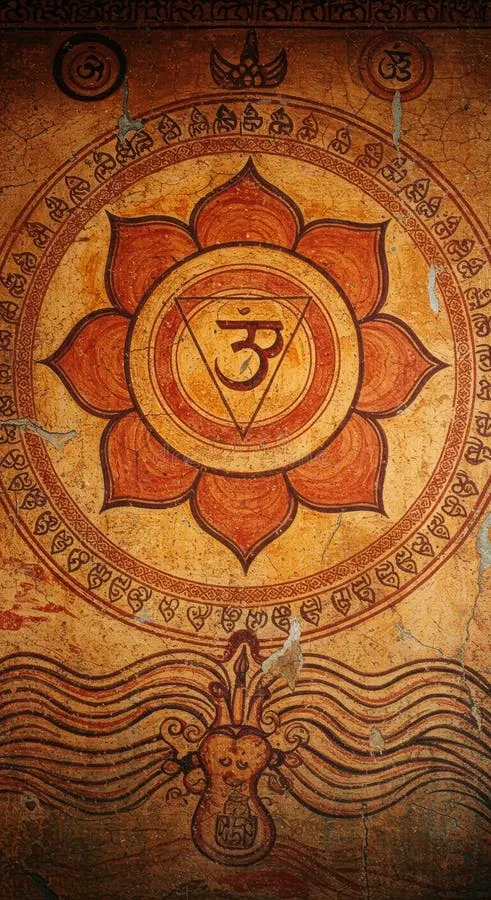
MANIPURA
Madalina Yoga Alliance E-RYT 500
The Fire at the Center of Life
The third chackra resides in the navel, our first doorway into existence.
Long before we drew a first breath, before we carried a name or a history, we were fed through a single cord of flesh. The navel is the quiet memory of that original belonging — proof that we did not arrive into this world as separate beings. We arrived already in relationship.
In the yogic tradition, this center flowers as Manipura, the City of Jewels. Too often it is shrunk down to willpower, ambition, discipline — the currency of the driven. These may be the visible sparks of a balanced third chakra, but they are only its surface, the smoke rising above a much deeper fire.
The fire of Manipura does not dominate life. It digests it.
Just as the body turns food into living tissue, the subtle fire of Manipura turns experience into wisdom. Joy, grief, desire, failure, love, loss — everything that touches us is offered to this inner flame. A healthy Manipura does not reject what comes, nor does it hoard it. It metabolizes. It lets life become consciousness.
This symbolism reaches far beyond the boundaries of yoga.
In Taoist internal alchemy, the Lower Dantian, resting just beneath the navel, is honored as the body's great reservoir of vital energy. Every practice begins by bringing awareness home to this center, where vitality is cultivated and consciousness grows still enough to be trusted. Power, in this lineage, is gathered by returning inward rather than reaching outward.
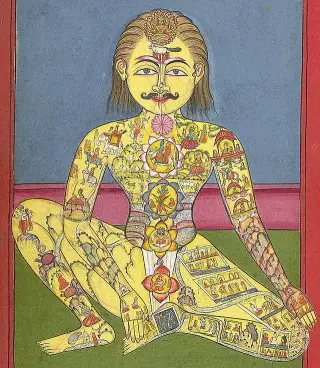
In Tibetan Vajrayana, the navel is one of the principal energetic centers of the subtle body. Practices such as Tummo, the Yoga of Inner Fire, kindle a flame at the navel — not merely to warm the flesh, but to transmute ordinary consciousness into awakened presence. Here too, fire is not destruction. Fire is transformation.
Fire has always held a sacred place in human civilization. It cooks, purifies, transforms, illuminates, warms. It is neither good nor bad; everything depends on how we relate to it. The same is true of the fire of Manipura. Left untended, it can harden into aggression, domination, endless ambition. Tended with awareness, it becomes courage, clarity, creativity, purposeful action.
In Ayurveda, this fire carries a name: Agni, the digestive fire. Agni is not confined to the stomach — it governs every act of transformation within body and mind. We digest food, yes, but we also digest emotions, experiences, relationships, victories, disappointments. Health, seen this way, is not merely the absence of disease. It is the sustained capacity to turn life into vitality.
When Agni burns clearly, the body is nourished, the mind grows lucid, and right action arises on its own. When Agni is weak, we may meet sluggish digestion, fatigue, confusion, a loss of direction, an emotional heaviness that will not lift. When it burns too fiercely, it can turn into inflammation, irritability, perfectionism, competitiveness, the relentless need to control.
Balance is not found in extinguishing the fire. It is found in tending it.
Hindu mythology carries the same intuition through a magnificent image. Vishnu rests upon the infinite cosmic ocean, and from his navel grows the lotus upon which Brahma, the creator, is born. Creation itself emerges from the divine center. The navel becomes the meeting place between the unmanifest and the manifest, between infinite consciousness and the world of forms.
Many esoteric tantric traditions describe the navel as a gateway into the inner cosmos. Some meditation technique concentrate on breathing through the navel as a return to the primordial space from which consciousness itself arises. The deepest voyage has always been inward.
Even modern science offers an unexpected echo of these ancient intuitions. For centuries, Western philosophy imagined consciousness as belonging to the mind alone, almost detached from the body — the body reduced to a vehicle, a machine, sometimes even an obstacle to higher awareness.
The neuroscientist Antonio Damasio radically challenged this view. Consciousness, he showed, does not arise independently of the body. It emerges from the brain's continuous reading of the body's internal state. Every heartbeat, every breath, every contraction of the gut, every shift in temperature, every visceral sensation contributes to the ongoing construction of the self. Before we think, we feel. Before we build a story about who we are, the body has already spoken.
Damasio describes feelings as the mind's perception of the body's changing landscape. Consciousness, in other words, is not suspended above life — it is born from life itself.
This is a remarkable bridge to the symbolism of Manipura.
The third chakra is often described as the place where experience is transformed into vitality, clarity, and purposeful action. Rather than treating the belly as some primitive part of ourselves to be mastered or overridden, both Tantra and modern neuroscience invite us to recognize it as a seat of profound intelligence.
The abdomen does more than digest. It is where we sense tension before we can name it, where excitement stirs before words arrive, where fear tightens, where courage expands, where intuition so often surfaces as a quiet, visceral certainty.
To cultivate awareness of this center, then, is not an escape into mysticism. It is a return to one of the most fundamental dimensions of human consciousness: the ceaseless dialogue between body and mind.
Perhaps this is the true jewel of Manipura.
Its fire is not the fire of domination or relentless willpower. It is the luminous intelligence that turns sensation into meaning, experience into wisdom, and life into conscious participation.
When we return our attention to the navel and the solar plexus, we are not turning away from reality. We are returning to the very place where consciousness continues, moment by moment, to take shape.
To heal Manipura, then, is not to become more controlling or more disciplined. It is to restore our capacity to digest experience — to feel fully without being consumed, and to let every encounter become nourishment for consciousness.
Manipura is not the center of domination. It is the center of participation. Its fire does not seek to conquer the world. It illuminates it.
The navel reminds us of something profoundly simple: life has always been flowing through us. We have never stood apart from it.
Because the deepest power is not the ability to control existence —
it is the courage to participate in it, completely, fully aflame.
Practice..breathing in the navel, Kapalabhati krya
Affirmation:The Fire within me transforms my experience into wisdom!