Dhumavati, the feared godess of Tantra
Her solitude, as the solitude of the infinite ♾️
Madalina Yoga Alliance E-RYT 500
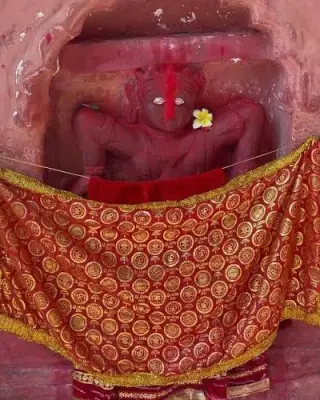
At Kamakhya, on Nilachal Hill in Assam, the ten Mahavidyas inhabit a sacred landscape of shrines and places of worship. Among them is maa Dhumavati, a goddess whose image can make people hesitate: grey hair, age, widowhood, hunger, solitude and especially austerity. Before we enter her temple, we have already encountered the things we fear losing. Youth. Love. Security. ..The familiar shape of our lives.[1]
I am interested in that hesitation. What happens when we move closer to the goddess whose appearance unsettles us? IS like all my fears are gathered in her depicted Image. HER fearsome presence can become an opening into a wider dimension of understanding, where the meanings we attach to beauty, absence and fulfilment begin to change, especially if we are on a spiritual pathway.
Dhumavati maa asks us to remain long enough for a difficult image to acquire depth and understanding. There is something demanding about a feminine divinity who stands before us aged and alone. How much space do we give such a woman in our imagination? Especially in a society that values the juice of youth, abundance and wealth .
These questions belong to our relationship with womenhood as much as to our relationship with the divine….
Dhumavati is invoked in left hand Tantric rites of uccāṭana, driving away an adversary or disruptive presence; māraṇa, bringing about an enemy’s destruction or death; and mohana, enchanting or bewildering another, clouding their perception and judgment. Her Aṣṭaka places these fearsome ritual powers alongside protection and liberation, revealing the many faces of a goddess whose domain embraces both worldly conflict and spiritual release.
Her sacred literature complicates every simple answer. The Dhumavati Sahasranama calls her Purna, complete; Jagatkartri, maker of the world; and Jaganmayi, she whose nature encompasses the world. It names her Brahmamayi, whose nature is Brahman, and Brahmanandapradayini, giver of Brahman’s bliss. The same hymn calls her both Vidya and Avidya, Knowledge and Ignorance.[2]
These names invite us to hold several faces together. Her apparent deprivation stands alongside fullness. The goddess associated with absence also contains the world. WHAT A WONDERFUL DICHOTOMY.
Ganapati Muni offers a particularly profound way into this complexity. In his Dhumavati chapter of the Mahavidya Sutra, he describes her as the Supreme’s sleep during cosmic dissolution. For liberated beings, she is the sleep of eternal bliss; for those caught in worldly existence, she appears as sleep, unconsciousness, forgetfulness and ignorance. This is an early twentieth-century interpretation within a Sanskrit spiritual tradition, rather than an ancient Upanishad speaking directly about Dhumavati.[3]
I find that distinction between experiences extraordinary. We commonly imagine wisdom as an accumulation: more understanding, more language, a more coherent account of ourselves. Here we encounter a teaching that also concerns the disappearance of the structures through which we ordinarily understand. I WONDER WHAT IF OUR WISDOM IS ONLY ANOTHER REFINED FORM OF IGNORANCE?
When something familiar falls away, the mind rushes to supply a replacement. A new explanation. Sometimes we can feel the urgency beneath it: the difficulty of allowing an interval in which we have yet to decide what our experience means.
Muni describes her inward worship through the relinquishing of conceptual determinations and calls this MAHAMAUNA, THE great silence. He connects it with bhumavidya, knowledge of the Infinite….I MEAN OAU..
Her theological reach includes revelation and concealment. His chapter also distinguishes liberating understanding from mere unconsciousness: blankness alone is insufficient, as is knowledge confined to objects. He brings vidya and avidya into a shared field of contemplation.[3]
This gives “ignorance” a difficult place in our inquiry. There is the ignorance through which we fail to know ourselves…CAN THE OBSERVER BECOME..the Obseved without bias? And also the limit at which our familiar instruments of knowing become inadequate. ..
These should not be casually equated. Yet their proximity asks us to be careful with our certainty, including spiritual certainty…
The Upanishadic connection deepens this. In the Chandogya Upanishad, the Infinite is described as that in which nothing other is seen, heard or known. Asked what supports it, the teacher replies that it rests in its own greatness, then qualifies even that answer. This passage does not name Dhumavati; Muni’s association provides the bridge.[4]
Through that bridge, her solitude can be contemplated as completeness without external support. Human loneliness has its own tenderness and pain. The aloneness suggested here concerns a reality with nothing outside it, nothing elsewhere that could make it more whole.
This is how I understand the intuition that she remains when everything ends. We can contemplate her as the reality in which forms arise and disappear. The image of the widow carries this question beyond the biography of a woman who has lost a husband and into the dissolution of the relationships by which existence becomes intelligible.
Even here, her texts refuse a tidy portrait. The Sahasranama names her Shambhupatni, Shiva’s wife, alongside identities associated with her widowhood. It also celebrates youth, adornment and jasmine flowers. Her many names exceed any one appearance.[2]
“Femininity without flowers” was the phrase that first came to me. Now I would let it breathe further. There is a feminine presence whose worth remains whole through beauty and age, adornment and austerity, companionship and solitude. Flowers can belong to her. So can the grey hair we are taught to conceal. Our difficulty lies in allowing the same woman to contain them all.
Her Ashtaka enlarges the image to a cosmic scale. At dissolution she wears the moon and sun at her ears, the stars around her neck, and carries Brahma’s skeleton. The verse asks her to remove fear. Later, as the world enters her mouth, she is addressed as the remover of the fear of death. The hymn places destruction and protection within one presence.[5]
I read this as an invitation to look closely at the refuge we seek. We ask life to protect the things we love, and that longing deserves tenderness. We also encounter changes that tenderness cannot prevent. Dhumavati opens a spiritual question within that encounter: what kind of understanding can accompany us through an ending?
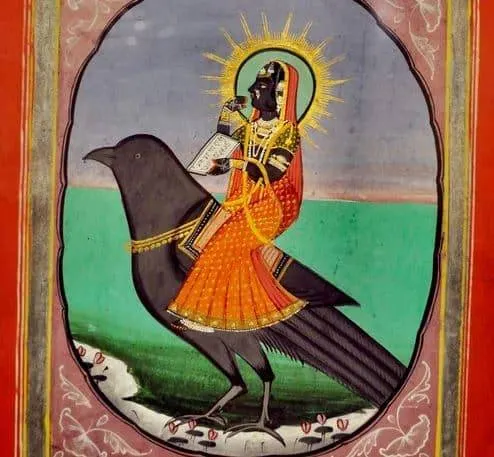
The crow belongs beside this question. In her traditional imagery it is associated with death and the cremation ground. It can be contemplated as a creature at the threshold of what the living world discards.[6] Her Sahasranama also names her mistress of bhutas, pretas and pishachas, categories of spirits and ghostly beings.[2] This gives textual substance to her connection with the unseen, while leaving specific claims about communication with the dead to particular traditions.
Her fierce ritual associations also deserve an honest place. The Ashtaka’s concluding verses mention expulsion, destructive rites, protection and eventual liberation.[5] The devotional literature holds worldly power and spiritual release together. Turning every frightening feature into a gentle metaphor would make her easier to accept, while diminishing the complexity that drew us toward her.
Her elderly form also contains other ages. The opening of her Aṣṭaka presents her as a maiden in the morning, mature at midday and elderly at evening, addressing her as Tribhuvanajananī, “mother of the three worlds.” Her image can therefore hold an entire cycle of existence within…
For me, entering Dhumavati’s temple begins with allowing that complexity. The elder woman, the hungry presence, the cosmic mother, the power of concealment, the giver of knowledge: each face asks something different of us.
There are losses that hurt without offering an immediate lesson. There are seasons of solitude that remain difficult. Austerity acquires meaning through the awareness brought to it, and deprivation deserves care. Within these experiences, Dhumavati offers an image through which to contemplate a completeness that our circumstances cannot easily describe.
We approach her carrying our measures of a fulfilled life. In her presence, those measures become visible. Staying with her means allowing the question to deepen: when the things through which I establish my worth fall silent, what remains available to be known?
What emerges for me is this: her apparent destitution can conceal completeness. Solitude, austerity and loss become places from which to contemplate a reality that remains whole as forms disappear…For me, she encompasses creation as well as its ending.
And also..it points toward a deeper, stronger truth. We all get old, lose our watever shiny atibutues we cling on, solitude is a existential attribute, we all die alone at the end…why shall we fear truth..deep absolute truth? So next time on the Nilachal Hill do not hesitate to visit the temple of Dhumavati maa.
Sources and textual notes..
[1] Maa Kamakhya Devalaya, official account of the temple complex and the Mahavidya shrines on Nilachal Hill: https://www.maakamakhya.org/about
[2] Dhumavati Sahasranama Stotra, preserved in Shakta Pramoda. Relevant verses: 14, 16, 21, 37, 78, 84, 102, 110 and 134. Sanskrit Documents supplies a transcription credited to the Muktabodha Indological Research Institute. English renderings here are close translations of selected epithets, not a published critical translation. https://sanskritdocuments.org/doc_devii/dhUmAvatIsahasranAmastotra.html
[3] Ganapati Muni, Mahavidya Sutra, Dhumavati chapter, especially sutras 3–9, 23–30 and 31–43. Consulted through an online Sanskrit transcription with English translation; its English glosses should be distinguished from the Sanskrit wording. https://munipy.com/Hinduism/Tantra-and-Beyond/Shaktism/Kavyakantha-Ganapati-Muni/Mahavidya-Sutra/7.-Dhumavati
[4] Chandogya Upanishad 7.24.1. The connection with Dhumavati is Muni’s interpretive association; the Upanishadic passage itself does not name her. https://www.wisdomlib.org/hinduism/book/chandogya-upanishad-english/d/doc239404.html
[5] Dhumavati Stotra / Ashtaka, especially verses 5, 8 and 9–13, with the concluding attribution to the Urdhvamnaya. The online edition identifies Shaktapramoda and Mantramaharnava as sources. https://sanskritdocuments.org/doc_devii/dhUmAvatIstotram.html
[6] David Kinsley, Tantric Visions of the Divine Feminine: The Ten Mahavidyas (1997), chapter on Dhumavati. Scholarly interpretation, consulted through an online transcription: https://vishvasa.github.io/devaH/AryaH/hindukaH/meta/articles/kinsley/tantric-divine-feminine/2_The_Individual_mahAvidyAs/07_dhUmAvatI/