Chakras for Daily Life, Part 6: Ajna
Ajna , Bhrumadhya, The third eye chackra
Madalina Yoga Alliance E-RYT 500
SIXTH CHAKRA · BHRUMADHYA
Ajna
The Eye Behind the Eyes!
“That which is the ear of the ear, the mind of the mind, the speech of speech, the breath of breath, and the eye of the eye.”
— Kena Upanishad
The Sanskrit word Ajna means command — but whose command? Not the command of the ego, nor the restless chatter of the thinking mind. Ajna points toward a deeper intelligence, an inner authority that does not arise from accumulated knowledge but from direct seeing. It is traditionally located at the bhrumadhya, the point between the eyebrows, though its subtle center is said to lie deeper within the head, at the meeting place of Ida and Pingala as they dissolve into Sushumna.
For this reason, Ajna has long been called the Guru Chakra. At the beginning of the spiritual journey, we look outward. We search for teachers, scriptures, methods, answers. The outer guru is indispensable, because he or she points us in the right direction. Yet every authentic tradition insists on the same truth: the highest function of the guru is to awaken the Inner Guru. There comes a moment when wisdom is no longer borrowed. It begins to arise from the silent depths of one’s own consciousness.
CORRESPONDENCES
Element (tattva) Beyond the five mahabhutas
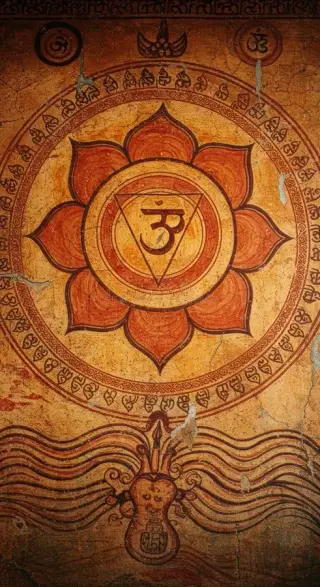
Petals Two — the dualities that become integrated
Bija mantra OM (AUM)
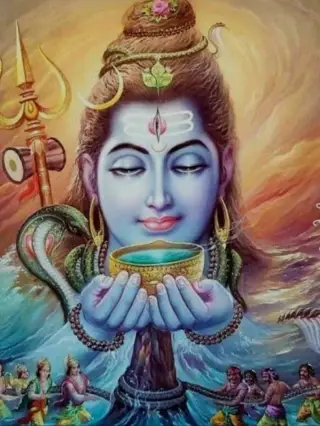
Deity Shiva as the Guru, with Shakti as Hakini
Gland Pituitary
Quality Intuition, viveka (discrimination), clarity, witnessing
THE EYE BEHIND THE EYES
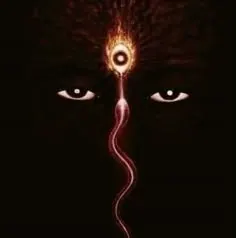
The third eye is not another organ hidden inside the forehead. It is the eye behind the eyes — the awareness through which every perception becomes possible. The physical eyes require light to see. The third eye asks another question: what remains when the light disappears?
The Upanishads answer with startling economy. The Kena Upanishad speaks of the ear of the ear, the mind of the mind — pointing to Brahman, the consciousness that makes every act of perception possible. The eyes do not truly see by themselves. The ears do not truly hear by themselves. They are instruments. What gives them life is awareness itself. We spend our lives looking through our eyes. Ajna invites us to discover the one who is looking.
The third eye does not see more. It sees from where all seeing begins.
LIGHT IN THE DARKNESS
Many meditators describe a deep blue or indigo light appearing at Ajna — stars, mandalas, luminous forms. Practitioners of Kundalini Yoga, Kriya Yoga, Kashmir Shaivism, and Siddha Yoga have described it across centuries. Swami Muktananda called it the Blue Pearl, Nila Bindu — a tiny, radiant point of consciousness he regarded as a profound manifestation of the Self. The Gheranda Samhita speaks of Jyotir Dhyana, meditation on the inner light; Kriya traditions describe a luminous spiritual eye ringed in gold, a white star at its center. Satyananda Saraswati taught that such lights, colors, and symbols are natural manifestations of the awakening subtle mind, to be observed without attachment.
These experiences are neither dismissed nor glorified. They are invitations. Eventually another question emerges, quieter than the light itself: who is aware of the blue light? Even light appears within awareness. Even darkness appears within awareness. Awareness itself neither comes nor goes.
The awakening of Ajna is traditionally linked to siddhis — heightened intuition, clairvoyance (divya dṛṣṭi), telepathic sensitivity, lucid dreaming, spontaneous insight into people or situations. The texts describe these openly, and warn just as openly: they are possible by-products of deep practice, never proof of enlightenment, and never the point of the practice itself.
WHERE IDA AND PINGALA MEET
In subtle anatomy, Ajna is where Ida and Pingala — the lunar and solar currents, the feminine and masculine, intuition and reason — merge into a single ascending current through Sushumna. The mind no longer oscillates between opposites; it becomes clear. Seen through a contemporary lens, this convergence has an echo in the body’s own architecture: the pituitary gland, seated almost exactly at the point tradition assigns to Ajna, governs the endocrine system much as this chakra is said to govern the subtle one — a small structure translating signal into wide, body-wide command. And the felt shift practitioners describe — thoughts arising and dissolving without being seized upon — maps loosely onto what contemplative neuroscience calls a quieting of default-mode activity: the mind's habitual narrating voice growing still enough for bare attention to be noticed as its own thing, distinct from what it observes. The traditions do not need this correlation to be true; but it is a fitting reminder that stillness practiced at the brow is not merely symbolic.
THE THIRD EYE OF SHIVA, KALI, AND THE BUDDHA
When Shiva opens his third eye, illusion burns. Desire — not life itself, but compulsive identification — is reduced to ashes. Kali’s third eye is fierce wisdom; she sees through every mask, every identity, every attachment, and nothing false survives her gaze. In Buddhism, the urna between the Buddha’s brows symbolizes awakened vision, the capacity to perceive reality as it is, free from delusion. Different faces, the same recognition: the third eye is not the ability to perceive extraordinary worlds. It is the ability to see this world without the veils created by the ego.
Blue has long carried this meaning — Shiva’s blue throat, Neelakantha; the deep blue of Krishna — evoking not a physical color but the limitless sky of consciousness itself. The Vedas pray, lead me from darkness to light, and the deepest light they mean is not brightness but the illumination of understanding. The Gayatri Mantra does not ask for power or miracles. Its final line asks only that the divine light awaken our intelligence — dhiyo, viveka, the capacity to discern the Real from appearances, truth from projection, wisdom from information.
THE FINAL KNOT
Yogic tradition speaks of Rudra Granthi, the Shiva Knot, situated at the level of Ajna — the most subtle of the three knots. It is no longer attachment to the body, nor to emotion. It is attachment to the spiritual self: I am the meditator. I am the seeker. I had the vision. I am becoming enlightened. The final knot is not ignorance of spirituality. It is identification with spirituality.
When Rudra Granthi loosens, something astonishing happens: even the path is released. Zen expresses this with characteristic boldness — if you meet the Buddha on the road, kill him — not because the Buddha is rejected, but because every image, even the most sacred, must eventually be relinquished. The seeker dissolves. The path dissolves. Only awareness remains.
It is not the awakening of supernatural vision. It is the disappearance of the one who believed he or she was looking.
A SIMPLE PRACTICE
Sit comfortably and let the breath settle into its own rhythm. Rest your attention gently at the space between the eyebrows, without forcing concentration. Allow thoughts to come and go while you remain the silent witness. If it feels natural, repeat OM silently with each exhalation. Rather than trying to open the third eye, cultivate a clear, effortless awareness — the eye behind the eyes needs no opening. It has never been closed.
AFFIRMATION
I see clearly. I trust the quiet intelligence that arises when the mind is still.
The Upanishads call it the eye of the eye. Tantra calls it the Inner Guru. Advaita calls it the Self. Different names, the same luminous silence.
What sees, when there is nothing left to see?