Gora and A-gora
About strange things...
Madalina Yoga Alliance E-RYT 500
In Hindi, gora means white or fair-skinned, and it is also used to refer to a white foreigner. A word that describes an appearance can become a way of identifying someone as coming from abroad, with a different culture and religion.
But what is a foreigner? What makes someone a stranger? These questions have followed me through my studies in sociology, where much of my research and writing focused on far-right parties, the fear of the other, and the place of the strange, and strangeness. They have also followed me through my life, because I have spent so many years living in so many countries other than my own. I have been that foreigner. I have been the stranger, I have felt on my skin the belonging and the not belonging. Sometimes even discrimination or other times curiosity.
I think we find strangers in others because we need to be reassured about ourselves. Because we are sometimes also strangers to ourselves. We define who belongs and who comes from elsewhere, who resembles us and who seems different. Through the other, we try to make our own identity feel more certain , powerful and reassuring. And yet, having been the stranger for so much of my life, I keep coming back to this question: how much of that strangeness belongs to the person, and how much belongs to the way we look at them and our own conditioning?
This brings me to Aghora. The resemblance between gora and aghora is a personal connection I am making between two different words…I m basically playing with words. AGORA comes from a- and ghora, meaning “non-terrifying.” Robert Svoboda describes it as “the spiritual path that seeks to negate all that is ghora (‘terrible, terrifying’) in life.” In his account, the practitioner approaches what evokes fear and aversion, seeking to move beyond the divisions that keep us caught in duality.SO watever disgust you shout not..because is a part of life..
That understanding touches something very deep in me. For me, the whole point of yoga is Oneness: seeing the other as yourself. That is spiritual life. ..and not only in yoga but most of spiritual traditions. We have differences, of course, and those differences are also the beauty of being alive. Each person carries their own history, culture, beliefs, and way of experiencing the world. Seeing life as one allows us to meet those differences while feeling the life we share on a common ground.
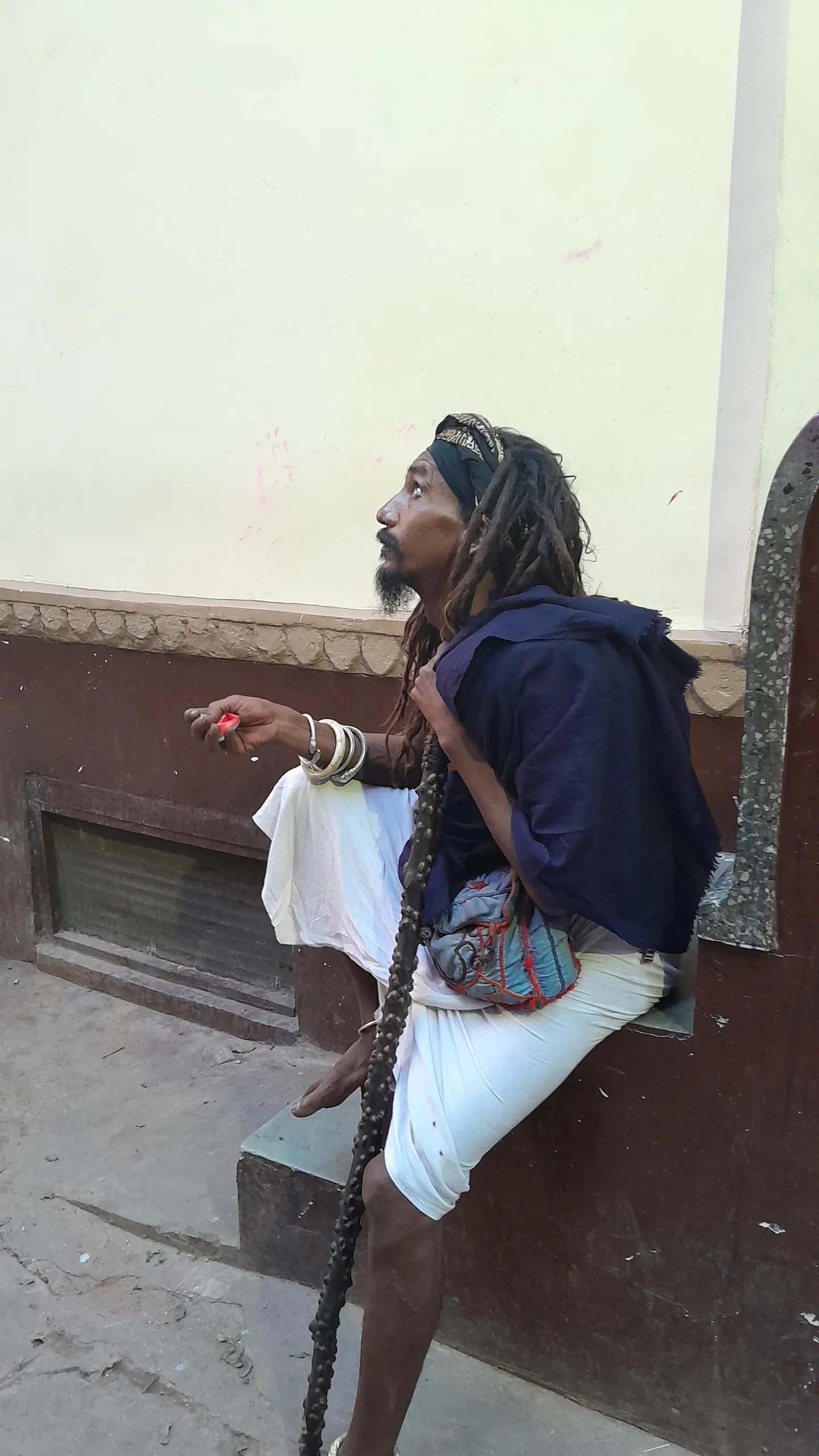
I spent some time with Aghoris in Varanasi on the ghats.We talked , did meditation and spent the night togheter by the temples and near Ganga maa on the cremation grounds. They are often looked upon with fear, associated with extreme renunciation, dark practices, and tantra. Around them, too, there is this feeling of the stranger: someone whose life seems so far from our own that fear can enter before we have even met them.
For me, what is most beautiful in Aghora is the possibility of meeting life without fear or disgust, of seeing the other and feeling that they, too, are part of the same whole. After so many years of being a foreigner, that has a very personal meaning. There is nothing more spiritual to me than moving towards that openness. Seeing life as one, with all its differences, is the most beautiful thing I feel we can achieve on our path.
For me living in India for so many years I don't feel like a gora anymore, but like an Agora, this country made me fearless, open to experience to non-judgement and to a certain depth that it was not there before. I mean you don't need to live in cremation grounds and put basma on your body to live a path wher you don't feel like labeling humans and experiences .A path where you walk from acceptance and tolerance, peace..not fear.Because wherever there is peace there is love.