Naga Panchami, the Serpent Guards
On Nāga Panchami and the sacred ambivalence of power
Madalina Yoga Alliance E-RYT 500
Nāgāya Namaḥ — Salutations to the Serpent
There are creatures that seem entirely at home in the visible realm, and others that appear to travel between worlds. The serpent belongs to the second kind. It has no legs and yet moves with extraordinary elegance,fast, writing curves upon the earth. It disappears beneath stones, roots and houses, enters water without becoming an aquatic creature,even if there are snakes living in water, sleeps underground and returns to the sun to recharge his cold bloded flesh. It sheds an entire version of itself , shedding layers of skin, and continues forward. It carries venom inside its body and regeneration inside its skin.
In history human beings have never quite known what to do with the serpent. We fear it, worship it, kill it, make medicine from its poison, place it around the necks of gods and imagine it sleeping beneath the foundations of the world, or our house.
On Nāga Panchami, India bows ttothe mighty power of The Serpent.
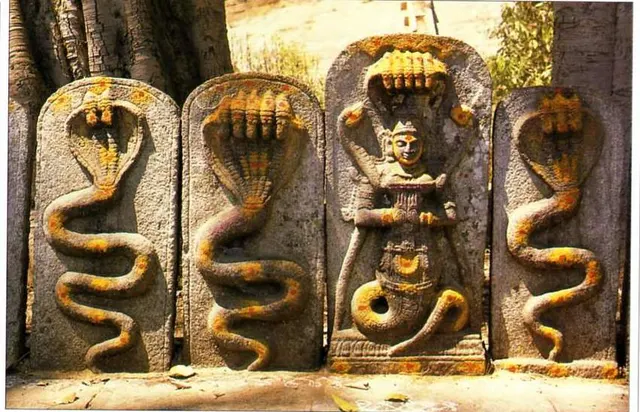
The nāga of Indian mythology is far more than the biological snake. Nāgas constitute a mysterious order of serpent beings associated with water, fertility, rain, treasures, protection, knowledge and the subterranean realms of Pātāla and Nāgaloka. They belong to the geography underneath ordinary existence, the underworld.. And the Indian underworld is not simply a place of punishment or evil. It can be extraordinarily beautiful, filled with jewels, palaces, treasures and powerful beings. What lies beneath the surface is dangerously scary, but it is also rich in treasures.
The serpent therefore becomes a guardian of what is hidden to the mortal eye.
❖
The One Who Sleeps Upon the Serpent…
One of the oldest and most magnificent images of this appears with Vishnu. Between cycles of creation, Vishnu rests upon Ananta Śeṣa, the immense many-headed cosmic serpent floating upon the primordial ocean, the origin of life.Ananta means endless, infinite; Śeṣa is that which remains. Before another world unfolds, the god of preservation sleeps upon the serpent.
The serpent is not an enemy beneath Vishnu. It is his support.
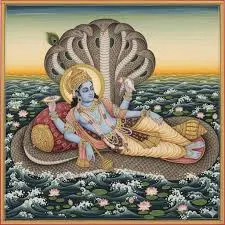
Beneath creation lies something ancient, coiled and immeasurable, and Vishnu trusts it enough to sleep upon it, ande feel protected by it.
Poison Before Nectar
Elsewhere, the serpent becomes the force through which the depths themselves are disturbed. During the Samudra Manthana, the churning of the cosmic ocean, Vāsuki, king of the nāgas, becomes the enormous living rope pulled between devas( god)and asuras( demos) They churn the primordial waters in search of amṛta, the nectar of immortality…
But immortality does not emerge first.Poison does.
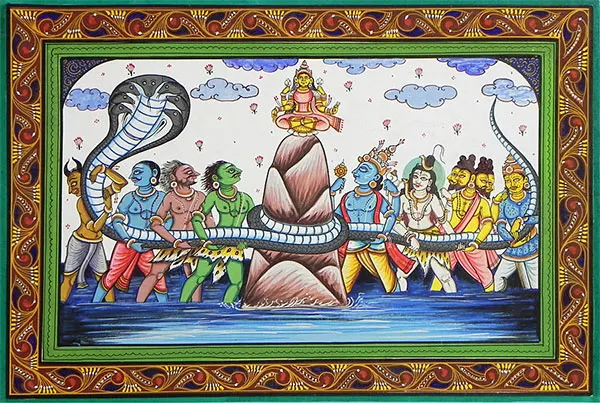
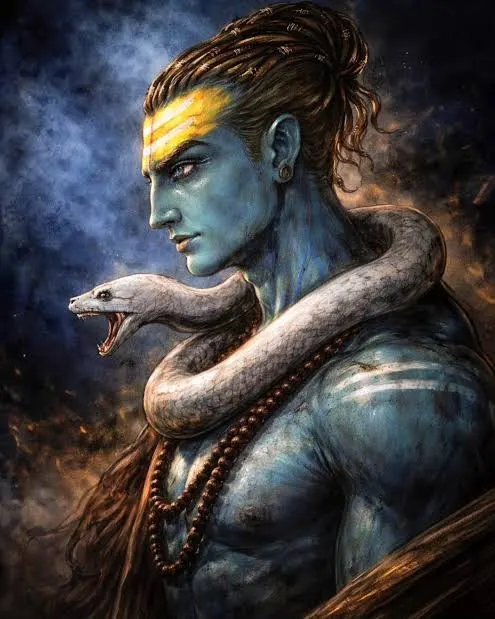
Before the nectar appears, the terrible halāhala rises from the depths, threatening creation itself. Shiva receives the poison and holds it in his throat, becoming Nīlakaṇṭha, the blue-throated one.
Disturb the depths and do not expect only nectar to rise.
Anyone who has seriously entered meditation, intimacy, grief, spiritual practice or transformation knows something about this. We descend believing we will discover wisdom and instead encounter jealousy, fear, old memories, desire, rage, attachment. We churn the unconscious and are surprised when the first thing rising toward us is poison. Do bot believe that the spiritual path is parched with flowers, is a inner churning and a rough inner journey.
Shiva does something remarkable with it. He neither swallows the poison completely nor spits it back upon the world. He contains it without becoming it.The vissudha (the throat chackra) chackra is blue because of that and we already discussed it during pi
And around that same throat rests a serpent. Shiva does not kill the nāga. He wears it as a necklace.
The Dance That Does Not End in Death
Krishna gives us yet another relationship with serpent power. The nāga Kāliya has poisoned the waters of the Yamunā. Krishna enters those poisonous waters, confronts him and dances upon his many hoods until the serpent submits. Yet Krishna does not finally destroy Kāliya. He allows him to leave….by the grace of god.
Again, the mythology refuses the easiest ending.
The dangerous power is not annihilated. It is brought back into order.
Then there is Takṣaka, the nāga king whose bite kills King Parikshit. Parikshit's son Janamejaya responds by beginning the Sarpa Satra, a terrible sacrifice intended to exterminate the serpents themselves. One after another, nāgas are dragged toward the sacrificial fire until the young sage Āstika intervenes and persuades the king to stop.
This story became deeply connected with traditions surrounding Nāga Panchami. Its message is strikingly different from the heroic mythology of killing the monster. Humanity cannot resolve its fear of the serpent by destroying every serpent, or cutting their venomous fangs as some snake chambers do.
Some relationship must be restored…
Other nāgas complicate the symbolism even further. Karkoṭaka, another serpent king appearing in the Mahābhārata, bites Nala, but his venom participates in transformation rather than functioning simply as destruction. Manasā Devī, particularly beloved in eastern India, presides over snakes, protection from snakebite, fertility and healing. Throughout India, serpent shrines and nāga stones connect these beings with families, land, water, fertility and protection.
It protects and poisons. It destroys and heals. It frightens and guards the humans.
❖
The Serpent Inside
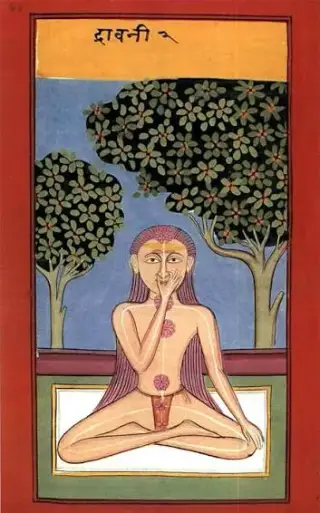
And eventually Indian spiritual imagination brings the serpent inside the human body. Kuṇḍalinī is described through the image of a coiled power resting at the base of the subtle body. The cosmic serpent has become intimate. What mythology placed beneath the earth now appears beneath ordinary consciousness.
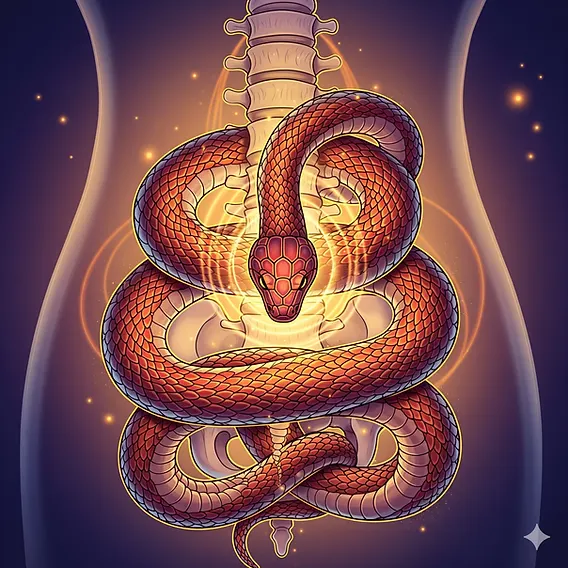
And perhaps this is where the nāga begins to resemble the swirling mind.
The mind knows how to coil. It winds itself around a memory and returns to it. It circles a fear until possibility becomes certainty. It wraps itself around desire, jealousy, regret and imagined futures. We pull desperately at these knots because we want to be free, but sometimes pulling is precisely what tightens them.
We think about how to stop thinking, how to stop ruminating inside.We analyze why we analyze.
We reconstruct conversations that ended years ago and rehearse conversations that may never happen. Eventually a thought bites, and its venom enters the body. The heart accelerates. Levels od corstisol rise. The stomach contracts. Sleep disappears. Something existing entirely within imagination has become physiological reality.
But the serpent itself is not the poison.
It carries poison.That distinction matters a lot.
Because the same mind that creates suffering creates poetry, mathematics, mythology, beautifull stories, tenderness and extraordinary perception. The same instinct that becomes terror can become intuition. The same force that coils itself into obsession can become concentration and a gateway to truth.The same Kuṇḍalinī that sleeps can rise and awaken a superhuman.
The problem was never simply the serpent. The question is our relationship with its power, from fear to reverence.
This may be why India's gods rarely need to exterminate it. Vishnu rests upon the serpent. Shiva wears the serpent. Krishna dances upon the serpent.
And on Nāga Panchami, the human being bows to it and ccelebrate i.
❖
Beyond India
There is something extraordinarily ancient in that gesture, and it reaches beyond India.
In old Balkan traditions there was also the serpent of the house, a mysterious household snake associated with the family, the land, the ancestors and protection. Killing it could be considered a terrible mistake. The creature disappearing beneath the foundations was not necessarily an intruder. It might be guarding the house as a protector spirit.
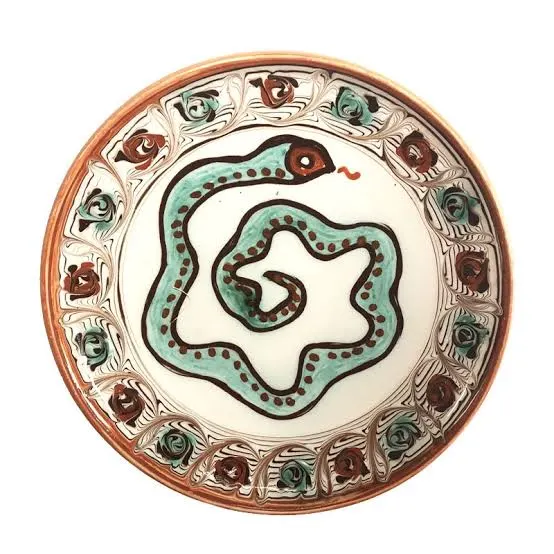
Thousands of kilometres apart, two cultures looked toward the ground and discovered something sacred moving underneath it, gracefully divine.
Even the Bible cannot fully cast the serpent as pure evil, however hard later theology tried.
In Eden, the serpent speaks first to Eve, not to threaten her, but to ask a question. It points toward a fruit already growing on a tree already planted by God. It does not plant temptation into a perfect world — it simply reveals that the tree of knowledge was always there to be explored and tasted.
What follows is not only a fall. It is a sacred initiation.
Eve eats, and something opens that cannot close again: awareness, shame, mortality, and free will. Paradise, after all, is a place without choice. Nothing has been decided there because nothing needs deciding. The serpent is what ends that innocence and begins the human condition , the free will to choose for ourselves, consciousness purchased at the price of exile for Paradise.
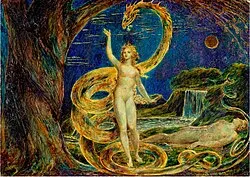
Read this way, the serpent in Genesis performs the same function it performs everywhere else. It is not simply the enemy of God. It is the one who moves between worlds , between the garden and the earth, between innocence and knowing, between what is given and what must be chosen. It initiates. It always initiates…
Adam and Eve do not stay children forever. Someone has to open the door to the unknown..
Perhaps that is because the serpent naturally belongs to the threshold. It crosses between surface and depth, water and earth, stillness and extraordinary speed and agility . It can remain motionless until movement becomes necessary. It does not conquer the landscape through rigidity. Its intelligence is fluidity and flowers, adaptation . Its entire body negotiates continuously with the world whie shedding older versions of itself.
Shedding..skin
And then it performs its most mysterious act.
It sheds.
At some point the skin that protected it becomes too small. The serpent rubs itself against earth and stone until the old surface splits. Then it crawls forward, leaving behind an almost perfect image of what it used to be his coverage.
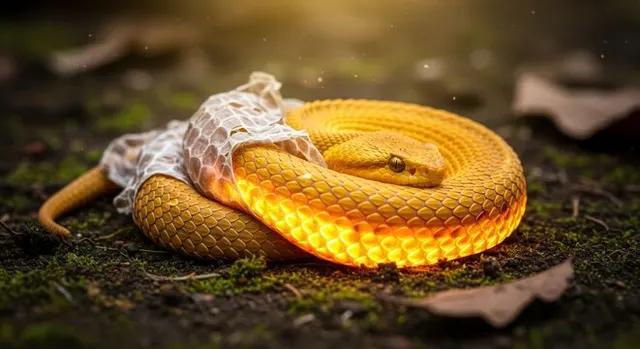
Perhaps humans have always looked at this and secretly envied it.
We carry old skins for years. Identities that no longer fit us anymore. . Loves that ended. Injuries we have turned into biographies. Ideas about ourselves that once protected us and later became prisons. We pull at our psychological knots, trying desperately to untie them, without noticing that sometimes transformation asks for something more serpentine, more letting goish’.
Not solving the old skin.
Leaving it behind the rocks for the earth to recive it back from where it came from.
AND ONE MORE SYMBOLISM THAT I REALLY LOOVE.
The Ouroborous!!!
The Serpent That Eats Itself
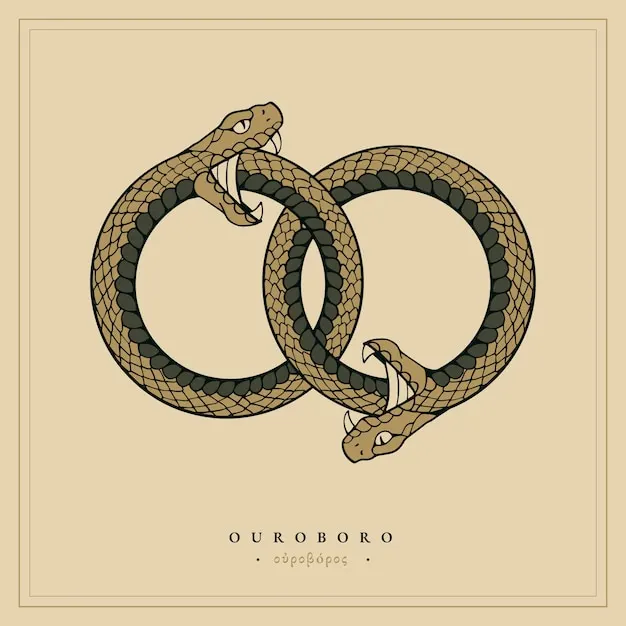
There is one more serpent still to name the one that belongs to no single mythology because it belongs to all of them at once.
The ouroboros eats its own tail. It has no beginning point and no ending point, only the continuous act of consuming what it already is. Alchemists drew it to signify the return of matter into itself — dissolution feeding creation, creation feeding dissolution, without a final residue left over. Gnostic and Egyptian traditions saw in it the boundary of the cosmos itself, the circle that contains time by swallowing it , the circular sacred time.
This is a different gesture than Vishnu resting on Śeṣa, or Shiva wearing the serpent at his throat. Those are images of relationship — a god and a power outside himself that he must learn to hold. The ouroboros collapses that distance entirely. Here the serpent is not beneath you, or around your neck, or in the water ahead of you,it is the time itself in a loophole.
It is you, eating yourself, becoming yourself, endlessly creature that creates.
Every ending is already feeding the next beginning. Every skin shed is already digested into the next self. The ouroboros is what the coiled Kuṇḍalinī looks like from far enough away — no longer a power waiting to rise, but a power that was always cycling, always complete, needing nothing outside itself to continue.Creation, sustainability and distractions all at once..infinite.
Maybe this is the furthest the serpent ever travels: from guardian, to threshold, to the shape of time itself.
❖ ❖
The Serpent Beneath Us..and within..
Nāga Panchami can therefore be read as something far more profound than a festival about snakes. It is an acknowledgment of our relationship with forces that cannot be completely domesticated: nature, instinct, sexuality, death, regeneration, thought, unconscious intelligence, the earth beneath our houses and the mysterious life underneath our carefully constructed identities and beliefs.
The serpent is frightening because it reminds us that not everything powerful belongs under human control, but it can be tamed and revered.
Perhaps this is precisely why it became sacred.
The serpent beneath the earth guards treasure. The serpent beneath Vishnu carries infinity. Vāsuki churns poison and immortality from the same ocean. Kāliya reveals what happens when power becomes poisonous. The serpent around Shiva's throat rests beside poison that has been contained but never denied in itself. Kuṇḍalinī sleeps beneath consciousness waiting for upward movement and awakening. And somewhere beneath an old Balkan house, another serpent quietly guards the foundations.
The serpent has been underneath us all along.
Is such a beautiful remembering that we live in a toghetrness with the world and it’s animals, and the more we look at it the more we see it’s powerful magic and poetry. Reinchanting the world and its mystery …
There is common imaginary around symbols that expand our imagination and creativity. We all are surrounded in our daily life by powerful symbols, let’s invite them inside our mind and let them coil till lessons are learned and bliss dropped upon ourselves like a drop of Amrita.
Closing Affirmation!
I bow to what moves beneath me and inside me.
I do not need to kill what I cannot control.
I learn the language of the coil,
and I let what no longer fits my be shed.