Śrāvana ,When Silence Begins to Speak
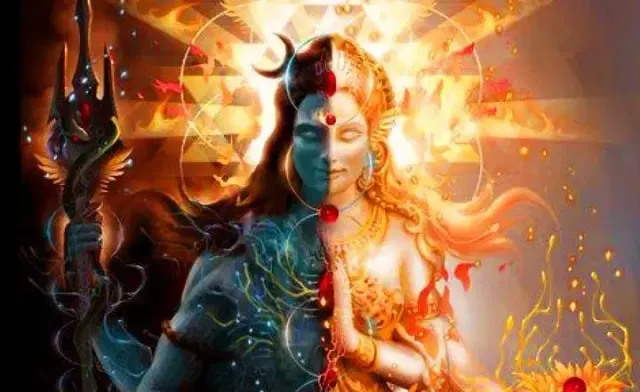
Shiva and Vāk Shakti, the divine couple unde the monsoon rains
Madalina Yoga Alliance E-RYT 500
I want to tell you a story about the poetry of monsoon in India during this month of august. Shravana is the fifth month of the Hindu lunar calendar and the Indian national calendar. The month corresponds to the monsoon (Varsha) season . Sravana is commonly called the month of Shiva. Throughout India, temples fill with devotees carrying water, Mondays become days of fasting and worship, and the month is associated with austerity, inwardness, devotion and the mysterious stillness represented by Shiva.
But there is something particularly beautiful hidden inside the name itself.
Śravana means Listening.
And the moment we begin to think seriously about listening, Shiva’s month unexpectedly opens toward Shakti, his beloved consort. And I wonder why all Indian stories have to end in a love story? Because in any tantric tradition there is no Shiva without Shakti.
Because what is silence without sound? What is Shiva without Shakti..only Shava(death).
And what is sound without the silence from which it emerges?
This question takes us into one of the most sophisticated ideas in Indian philosophy: Vāk, the sacred power of speech.
Vāk is far older than most of the Tantric systems with which we now associate her. She appears with extraordinary force in the Rig Veda, particularly in the famous Devī Sūkta, RIg Veda 10.125.And something remarkable happens in this hymn.
The Goddess speaks for herself.
She does not merely represent human speech. She presents herself as a cosmic power moving through gods, humans and the structure of existence itself. She describes herself as sovereign, as the one through whom perception and knowledge become possible, and even as a creative power underlying the cosmos. Already, thousands of years ago, speech was therefore being imagined as something far greater than language.
Vāk is manifestation.
And this idea becomes increasingly subtle as it travels through Indian philosophy, Tantra, Śrī Vidyā and Kashmir Shaivism.
Before the Word..We normally imagine speech beginning when somebody opens their mouth.Indian theories of Vāk ask us to look much earlier.
Before I say something, there is a thought. Before the thought becomes a sentence, there is perhaps an intuition. And before even the intuition, what is there?
The Tantric tradition eventually articulates this movement through the famous four levels of Vāk:
Parā — Paśyantī — Madhyamā — Vaikharī.
Vaikharī is the speech we hear: articulated language, carried through breath, throat, tongue and mouth.
Madhyamā is interior speech. The sentence exists, but I have not spoken it yet.
Paśyantī is stranger. The Sanskrit root paś means “to see.” At this level, meaning has not yet fragmented completely into words. There is something closer to a direct perception, an intuition pregnant with language.
And Parā Vāk is subtler still: speech before speech, undifferentiated possibility before speaker, meaning and word have separated.
But even this description is inadequate, because it makes the process look like a neat staircase.It is more radical than that.
The theory suggests that what comes out of our mouths is only the outermost surface of an enormous interior event..Speech has depths.
Śrī Vidyā: The Goddess as Mantra
This becomes particularly beautiful in Śrī Vidyā, the Tantric tradition centred upon the Goddess Lalitā Tripurasundarī.Here the universe itself can be contemplated as the unfolding of Śakti.
The Śrī Cakra expresses this metaphysically and ritually: multiplicity radiates from the bindu, while contemplative practice travels through multiplicity toward the centre.
Language participates in the same movement.
The Sanskrit letters are not treated merely as arbitrary symbols. Through the doctrine of the **Mātrkās—the Mothers, the powers of the letters**phonemic differentiation itself becomes a form of Śakti.
Mantra therefore means something considerably more profound than repeating a spiritually pleasant sentence.
Sound is power because manifestation itself is power.
The connection between Śrī Vidyā and Vāk is particularly explicit in the tradition surrounding the Lalitā Sahasranāma, whose revelation is traditionally associated with the Vāgdevīs, goddesses of speech, acting at Lalitā’s command.
Here language is not merely talking about the Goddess.
Language is one of the ways the Goddess becomes present.Therefore language is sacred.
And suddenly our ordinary distinction between silence and speech begins to collapse.
Shiva as Light, Shakti as the Power of the Light
This is where Kashmir Shaivism gives us another extraordinary vocabulary.
It speaks of prakāśa—luminosity, the self-shining nature of consciousness—and vimarśa, consciousness’s capacity to know itself.
We could poetically call the first Shiva and the second Shakti.
Shiva is luminosity.
Shakti is not another substance added to the light. She is the power inherent within consciousness by which the light becomes aware, expressive, creative.
And perhaps this gives us a more subtle way of thinking about sound.
If Shiva is light, Vāk is not simply “noise produced by Shakti.”
Vāk is light becoming articulate and vibrated.
This is why the Tantric language of nāda, bindu, spanda, mantra and Mātṛikā becomes so compelling.
Nāda is sound, but not necessarily audible sound.
Spanda is vibration, but not simply mechanical vibration measurable in air.
Bindu is the point, the concentrated potential in which differentiation has not yet unfolded.
These are attempts to speak about something that ordinary language almost immediately damages: the threshold at which undivided consciousness becomes experience.
Light and sound.Prakāśa and Vimarśa.Shiva and Shakti.
Not two substances meeting each other, but two ways of describing one reality in the act of becoming manifest.
!And Then Comes the Problem of Truth!
Our conversation about Vāk led somewhere I had not expected. If Vāk is Shakti, what happens when we lie?
The easy answer would be that truthful speech is Shakti and lying somehow violates her.
But philosophically, that cannot quite work.
If Shakti is genuinely the power of manifestation, then nothing manifested can stand outside Shakti.
A lie is also Vāk.
Manipulation is Vāk.Poetry is Vāk. Gossip is Vāk. A declaration of love is Vāk. Propaganda is Vāk. Mantra is Vāk.
Silence chosen to protect someone can be Vāk, and silence chosen to deceive can participate in the same power of concealment.
Now the question becomes far more uncomfortable…….
Shakti does not merely reveal.
She also veils.
Indian traditions have wrestled endlessly with this paradox through ideas of Māyā, limitation and concealment. Kashmir Shaivism makes the problem particularly interesting because Māyā cannot ultimately be an independent force standing outside consciousness.
The power to conceal must belong to the same reality as the power to reveal.
And perhaps this tells us something fascinating about speech.
A lie does not demonstrate the absence of Vāk Shakti.
It demonstrates her terrifying freedom.
The same extraordinary capacity through which consciousness makes the invisible visible can also make what is absent appear present.
Human speech can disclose reality.
Human speech can manufacture another one.
The instrument is the same.
This is where satya, truthfulness, becomes much more interesting than the moral instruction “do not lie.”
Satya can be understood as coherence between levels of speech.
And perhaps distortion begins long before the lie leaves the mouth.
Śrāvana: The Practice of Listening
Which brings us back to Śrāvana.
Shiva’s month. The month whose name evokes listening.But it also Vak Shakti’s moth.
Perhaps there is something almost perfect about this coincidence.
We usually associate spiritual practice with speaking: prayers, mantras, teachings, vows, explanations. But before Vāk becomes Vaikharī, something has to be heard.
And listening may be one way of following speech backwards.
1. We hear the spoken word.
2. Then we notice the thought beneath it.
3. Then the intention beneath the thought.
4. Then perhaps something subtler still: the almost invisible movement through which consciousness prepares to become expression.
Eventually we arrive at the edge of silence.
And this is where Shiva and Vāk Shakti become impossible to separate. A love story unfolding under the green luscious medows of Sharvan.
Shiva is not simply the silence opposed to Shakti’s noise.
Shakti is the capacity of silence to become sound.
And Shiva is present within every sound as the luminous field that makes its appearance possible.
Perhaps this is what makes listening such an extraordinary spiritual act.
And somewhere at that impossible threshold, the distinction between Shiva and Shakti disappears.
There is no longer silence on one side and sound on the other.
There is only consciousness intertwined as one.
Silent enough to contain the universe, and alive enough to speak it into being.
This is the love story under the monsoon raindrops. Shiva and Vak Shakti.
Let’s celebrate Śrāvana into meditative silence but also by speaking the truth as honoring the divine in us.