THE SACRED BODY Rediscovering the Axis Mundi
Replacing the body in the center of the world
Madalina Yoga Alliance E-RYT 500
“The gods are in the body as cows are in a stable.”
— Atharvaveda
There is a curious paradox at the heart of modern civilisation.
Never before have we known so much about the human body. Never before has it been so difficult simply to inhabit it.
We map the nervous system. We sequence the genome. We transplant organs, replace joints with titanium, watch thought flicker across the brain in sophisticated imaging. We count our steps, analyse our sleep, measure our heart rate, optimise our nutrition. The body has become transparent to science, visible to medicine, endlessly available to technology.
And yet, amid this accumulation of knowledge, another form of knowing has quietly faded. We have become experts at understanding the body from the outside, while gradually forgetting what it means to experience the world from within it.
The distinction is subtle. It changes everything.
For the body is not an object among other objects. It is the place from which every experience of reality begins. Before we named the world, we encountered it through the body. Before philosophy, there was breathing. Before theology, there was the beating of the heart. Before temples were raised toward the heavens, before sacred mountains were climbed, before scriptures were written or rituals performed, there already existed another sanctuary entrusted to every human being: the living architecture of the body itself.
Our first relationship with existence was never intellectual.
It was embodied.
The warmth of sunlight on skin. The roughness of stone beneath bare feet. The scent of rain carried on wind. Hunger. Silence. The embrace of another human being. Long before we tried to explain reality, we were already participating in it — through sensation, before thought.
Perhaps this is why so many traditions, separated by oceans, languages, and centuries, arrived at the same intuition without ever comparing notes. In India, the body became a mandala inhabited by deities and subtle currents of consciousness, and the ground beneath every temple was laid out as a body too — the Vastu Purusha, dreaming beneath the foundations. Among the Andean peoples, life unfolded in reciprocity with Pachamama and the Apus, the mountains understood as living presences. Across the Mongolian steppe, the shaman climbed a cosmic tree whose invisible trunk joined heaven, earth, and underworld, as Yggdrasil did for the Norse. Jewish mysticism gave this body a name — Adam Kadmon, the Primordial Man, whose form mirrors the architecture of creation. Taoist sages watched the rhythms of rivers and stars repeat themselves inside the human organism. Christian scripture called the body a temple of the Spirit. Sufi poets called the perfected human a mirror in which the Divine beholds its own beauty.
These traditions differ profoundly — in language, in cosmology, in what they ask of us. It would be too easy, and untrue, to claim they teach one doctrine. But they converge on something quieter than doctrine: the sense that the body is not an isolated object moving through an indifferent universe. It is the place where the universe becomes intimate.
Traditional cultures often began from a different assumption than we do.
They understood existence not as a collection of separate objects, but as a field of relationship.
The forest was not scenery. It was community.
The river was not a resource. It was kin.
The mountain was not landscape. It was presence.
And the body, in this understanding, was never simply an organism. It was the place through which these relationships became possible. It did not stand opposite the world. It belonged to it.
The Axis Mundi
Few scholars pursued this intuition as far as Mircea Eliade. Across a lifetime of study, he kept encountering the same structure: every traditional civilisation sought a centre — a mountain, a tree, a pillar, a temple, a fire — where heaven and earth remained in communication. He called it the Axis Mundi. Not a metaphor. A place through which the cosmos became ordered, and human life could find its bearings again.
But perhaps the deepest implication of Eliade's insight has rarely been followed to its end.
What if the first Axis Mundi was never outside us?
What if the first sacred mountain humanity ever climbed was the spine?
What if the first temple was not built of stone, but of flesh?
To rediscover the body as an Axis Mundi is not to place ourselves at the centre of the universe, as though everything revolved around the self. It is almost the opposite. It is to rediscover the centre from which separation begins to dissolve — the point where earth and sky, matter and consciousness, self and cosmos continually meet.
We have not simply desacralised the world. We have altered the way we participate in it. The body has slowly become something we possess, rather than the place from which we belong. And perhaps this is why so many people today, amid extraordinary abundance, carry an unmistakable sense of exile — rarely named in religious language, more often felt as anxiety, restlessness, distraction, or the quiet intuition that something essential has gone missing.
Perhaps what has been lost is not belief.
Perhaps it is belonging.
What follows is not an attempt to recover an ancient religion, or to argue that every tradition secretly teaches the same thing. Their differences matter, and deserve to be honoured. But beneath those differences lies a single question, asked in many languages:
What would it mean to inhabit the body again — not as an object moving through the world, but as the living place where the world continuously reveals itself?
I. INDIA — THE LIVING SRI CHAKRA
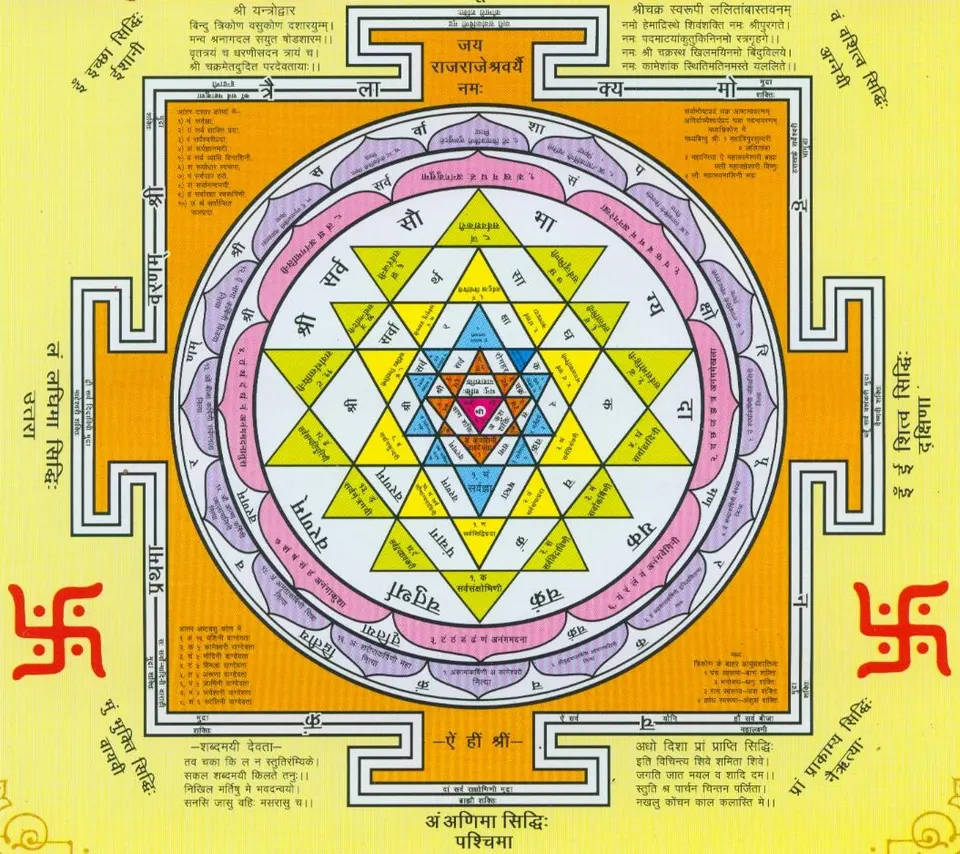
Among the world's traditions, Tantra may be the most radical, because it refuses a division that has shaped so much religious thought. Matter is not opposed to spirit. The senses are not enemies of awakening. The body is not a prison for the soul, nor a vehicle to be discarded on the way to something higher. It is the very place where consciousness reveals its own creativity.
Many spiritual paths begin with renunciation. Tantra begins with recognition.
The Sanskrit word for this — pratyabhijñā, central to the non-dual teaching of Kashmir Shaivism — means exactly that: recognition. Not the acquiring of something new. The remembering of what was already true.
In the Kaula and Sri Vidya lineages, the body is not compared to the Sri Yantra. It is a living incarnation of it. In the ritual of nyasa, the practitioner places the fifty-one matrikas — the Sanskrit letters, understood as the Goddess herself in the form of sound — upon the different points of the body. Nothing is symbolised here. Something is uncovered, syllable by syllable, that was there all along.
This is the essential difference between devotion and recognition: the Goddess is not summoned from elsewhere. She is found to have never left.
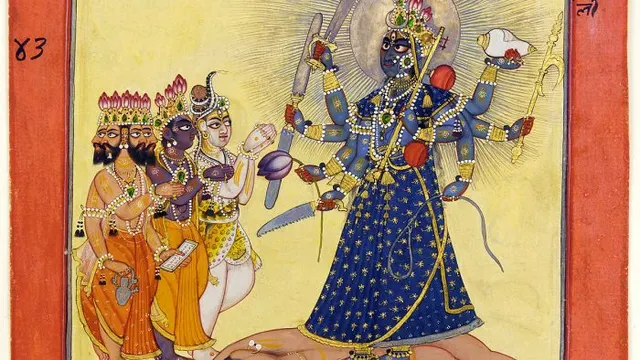
The Tantric masters speak of the body as pinda, the individual form, in exact correspondence with the brahmāṇḍa, the cosmic form. We tend to translate this as "microcosm and macrocosm" — but that phrase suggests two mirrors facing each other across a room. The Tantric vision is subtler than that. The body is not a miniature copy of the universe. It is one of the ways the universe continuously makes itself.
Every breath, a participation in the movement of the atmosphere.
Every heartbeat, a rhythm older than the species that beats it.
Every cell, made of matter forged inside dying stars.
Long before astrophysics confirmed that we are, quite literally, stardust, the sages of India had already sensed that the individual and the cosmos could never be pulled fully apart.
The chakras belong to this same vision. Modern culture likes to imagine them as spinning wheels of colour, waiting to be balanced. The classical texts offer something far less decorative: maps of participation, describing how consciousness contracts itself into a single body — and how it might, syllable by syllable, remember its own vastness.
Mulādhāra is not simply survival. It is belonging to the Earth.
Svādhiṣṭhāna is not merely sensation. It is learning to flow with the rhythms of existence.
Maṇipūra is not only willpower. It is the fire through which creation becomes action.
Anāhata is not only love. It is resonance — the discovery that the heart already vibrates with the pulse of the universe.
Viśuddha is not merely expression. It is the purification through which truth moves freely between the visible and the invisible.
Ājñā is not supernatural sight. It is the slow dissolving of the illusion that perception ends at the senses.
Sahasrāra is not an escape from the body. It is the recognition that the body has always been an expression of the infinite.
Seen this way, the chakras stop being objects to fix. They become invitations to inhabit existence more completely — to become, not more spiritual, but more intimate with what already is.
II. INDIA — VASTU, THE BODY LAID BENEATH THE EARTH
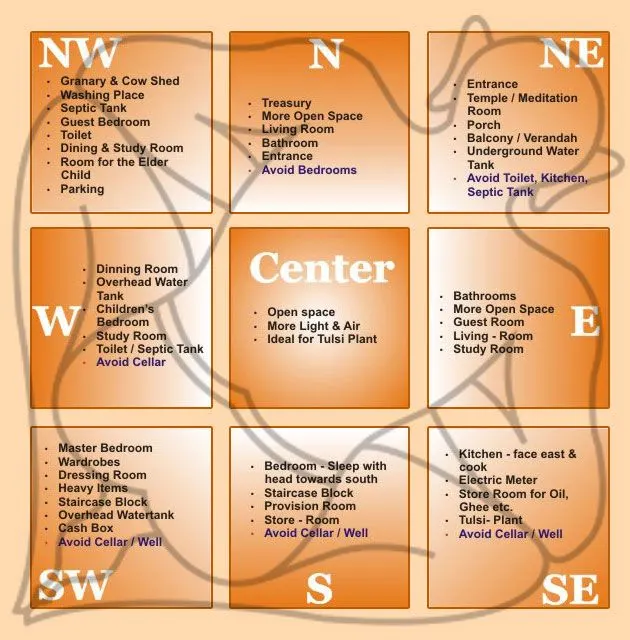
If Tantra places the Goddess inside the body, Vastu Shastra performs the inverse, equally vertiginous gesture: it lays a cosmic body beneath every house, every temple, every city that is built.
Legend tells that Brahma gave birth to an immense and famished being, the Vastu Purusha, who devoured everything in his path. The gods subdued him and pinned him to the ground, face down, crouched — and it is this immobilised posture that still becomes, to this day, the underlying plan of every sacred building raised in that tradition.
The site to be built upon, then, is never a neutral space. It is, literally, the body of the Vastu Purusha — his head toward the northeast, his feet toward the southwest, each organ corresponding to a precise zone of the plan. To build, in this understanding, is to remember that one inhabits a body before one inhabits a house, and that an imbalance in one will echo, sooner or later, in the other.
At the exact centre of this reclining body lies the Brahmasthan — the navel through which subtle energy is said to descend and nourish the whole structure. It is left open. Uncovered. The way one might leave a heart free to beat.
"The site plan is his body, and is treated as such."
What Vastu adds to this journey is a further widening of scale. After the body as microcosm, after the body as divine architecture, here is a body that extends beneath our feet — into the very geometry of the homes we live in. The sacred, in this vision, does not stop at the skin. It continues under the ground we walk on, in the foundations of everything we call shelter.
III. KABBALAH — ADAM KADMON, THE PRIMORDIAL MAN
The Jewish mystical tradition carries, almost word for word, the same intuition.
Adam Kadmon — the Primordial Man — names, in the Zohar and the kabbalistic literature that follows it, the totality of divine emanation organised into a human form, structured through the ten Sefirot. This is not offered as poetic ornament. In kabbalistic thought, what happens in the earthly body ripples directly through the structure of the divine itself. The human body becomes an instrument capable of acting upon the fabric of a higher reality.
"Bodily actions on earth matter, because they are directly reflected in the divine sphere."
Nothing done here is small. Nothing is merely private.
IV. TAOISM — THE BODY AS INNER LABORATORY
In China, the tradition of Neidan — inner alchemy — offers a parallel cartography, drawn with its own patience.
The body, in this vision, is populated by internal deities and threaded by meridians that function as celestial rivers in miniature. The practice consists of slowly refining three substances — jing, essence; qi, vital breath; shen, spirit — and carrying them upward, toward union with the Tao.
The sinologist Kristofer Schipper, in his landmark study of the Taoist body, showed that this cosmology was never merely metaphorical. It structures Chinese ritual and meditative practice with the same demand for precision one might bring to building a temple to exact proportions. Nothing here is rushed. The alchemy is inner, and it takes as long as it takes.
V. CHRISTIANITY — THE TEMPLE OF THE SPIRIT
Writing to the Corinthians, the apostle Paul left behind a sentence that would shape an entire civilisation: Do you not know that your body is a temple of the Holy Spirit within you?
Far from a simple call to purity, this line installs, at the very centre of Christianity, the same architecture found in India and in the Kabbalah: the body as dwelling place of the divine, rather than as an obstacle to it.
Centuries later, the theologian and paleontologist Pierre Teilhard de Chardin — placed by some comparative scholars alongside the Vedantin philosopher Ramanuja — extended this intuition further still, proposing a vision in which the whole world, the body included, becomes the body of the divine: charged with a presence that asks only to be recognised, rather than fled.
VI. SUFISM — AL-INSAN AL-KAMIL, THE PERFECT HUMAN
The Andalusian mystic Ibn Arabi brings this long journey to its most luminous formulation.
For him, the entire universe is a mirror, reflecting the divine attributes back toward their source — and the human being who reaches spiritual fullness, the Insan al-Kamil, becomes its most perfect mirror: the exact point where heaven and earth touch. Made, as scripture says, "in the image of God," the accomplished human recapitulates within a single body the whole of creation. Not merely a reflection of the divine — but, in Ibn Arabi's own words, the place where God contemplates His own perfection.
"The world is but a mirror, and phenomena are only its reflections."
THE FORGOTTEN ART OF BELONGING
If a single thread runs through the wisdom traditions of humanity, it is not the promise of salvation, nor the pursuit of extraordinary experience.
It is the restoration of relationship.
The Sanskrit tradition calls the forgetting of this avidyā — not a lack of information, but a forgetting of one's true nature. Buddhism speaks of attachment to the illusion of a separate self. Taoism describes the suffering born of opposing the Tao's spontaneous movement. Christian mystics speak of exile from God. Sufis speak of separation from the Beloved. Indigenous traditions, more often, speak simply of forgetting our kinship with the Earth.
Different languages.
One human experience.
Modern developmental psychology arrives at something similar from another direction entirely. Infants do not enter the world with a fully formed sense of separateness. Before language, before memory, before identity, there is touch — the rhythm of a heartbeat, the warmth of another body, a gaze that tells us we exist. We become ourselves through relationship, long before we ever imagine ourselves as separate.
Perhaps adulthood was never meant to undo this. Perhaps maturity simply means widening the circle: from the mother, to family, to community, to the Earth, and — for many traditions — to the whole of the cosmos.
Seen this way, spiritual practice is not an escape from ordinary life. It is an education in belonging.
Meditation is not primarily about controlling the mind. It is learning to become intimate with the present moment.
Yoga is not simply the stretching of a body. It is the remembering that body, breath, and awareness were never truly separate.
Prayer does not convince God to intervene. It makes the heart available to something larger than itself.
Pilgrimage is not tourism. It is walking until the world begins to speak again.
Even love looks different from here. Modern culture often imagines love as possession — my partner, my child, my friend — until attachment quietly becomes ownership, and expectation replaces presence. But every contemplative tradition points elsewhere: love is not possession, it is participation. To love another is not to fold them into our own story, but to take part in their freedom. The deepest relationships are the ones in which both people become more themselves, not less.
A forest becomes timber the moment participation is replaced by possession. A river becomes a resource the moment relationship is replaced by ownership. The body itself becomes a machine the moment wonder is replaced by control.
Perhaps this is the hidden crisis beneath our sophistication: our technologies have never been more advanced, and our relationships have rarely felt so fragile. We communicate instantly across continents, and feel, often, profoundly alone.
The answer to that loneliness cannot be manufactured. It cannot be downloaded. It cannot be purchased.
Belonging is not something we create.
It is something we recognise — the way the Tantric sage recognises Shiva already present in the body, the way the Andean farmer recognises Pachamama in the soil, the way the Vastu architect recognises the centre before laying the first stone.
The sacred has never been elsewhere.
It is the quality of relationship itself.
COMING HOME
Perhaps we have misunderstood the spiritual journey.
For centuries we imagined it as an ascent — climbing, rising above the ordinary, transcending the body, transcending desire, transcending the world itself. The language of spirituality has so often been the language of elsewhere.
Elsewhere. As if truth were waiting somewhere other than here.
But there is another possibility, whispered quietly through the contemplative traditions of the world: what if awakening is not an ascent, but a return?
Not a return to the past. Not to childhood, nor to some imagined state of purity. A return to the astonishing simplicity of being fully here.
A return to the body.
Not because the body is perfect. Because it is real.
This body that breathes without asking permission. This heart that has been beating since before we had our first memory. These hands that have touched those we have loved, and those we have lost. These eyes through which an entire universe has been unfolding since the day we were born.
We spend so much of our lives trying to become someone else that we rarely notice the miracle of simply being someone.
The sacred has never demanded perfection. It has only ever asked for presence.
To breathe consciously.
To walk slowly enough that the earth can be felt beneath the feet.
To eat with gratitude.
To listen without preparing a reply.
To hold another human being without trying to possess them.
To let silence become full, rather than empty.
These gestures look almost insignificant. Yet civilisations have been built upon their forgetting — and lives have been remade by their remembrance.
The sacred body is not an achievement. It does not belong only to saints, yogis, monks, or mystics. It belongs equally to the child laughing in the rain, the old woman tending her garden, the craftsman shaping wood with patient hands, the dancer disappearing into movement, the mother nursing her child, the pilgrim crossing a mountain pass.
The sacred is not a profession. It is a way of participating.
The body remains, perhaps, our most patient teacher. It never lives in yesterday. It never breathes tomorrow's air. It knows only this inhalation, this exhalation, this heartbeat, this step — inviting us back, again and again, into the only place life has ever actually happened.
The present.
This is not a rejection of science, nor a romantic longing for lost civilisations. Science tells us, with its own kind of wonder, that every atom within us was forged inside a star. Ecology reminds us that no living being exists in isolation. The ancient traditions arrived at this humility through contemplation; science is arriving at it through observation. Different languages, converging on the same truth:
We are far less separate than we imagined.
When we touch the earth, the earth is touching itself.
When we breathe, the atmosphere becomes breath.
When we look into another person's eyes, the universe briefly becomes aware of itself, through two lives meeting in a single moment.
Mircea Eliade wrote that every civilisation searched for an Axis Mundi — a place where heaven and earth could meet. We have climbed sacred mountains and built temples, mandalas, and cities in search of that centre.
But perhaps the oldest Axis Mundi has been quietly waiting for us all along.
It is this living body. This breathing body. This vulnerable, miraculous body — through which the stars become thought, the earth becomes touch, silence becomes awareness, and love becomes visible.
To rediscover the sacred body is not, in the end, to become more spiritual.
It is to become more human. To realise we were never spectators of existence.
We have always been participants.
“I am the temple. I am the threshold. I am, already, what I seek.”