There Are Many Ways to Make an Indian God
Lord Ganesha and how creation is not sentimental about its previous shapes..
Madalina Yoga Alliance E-RYT 500
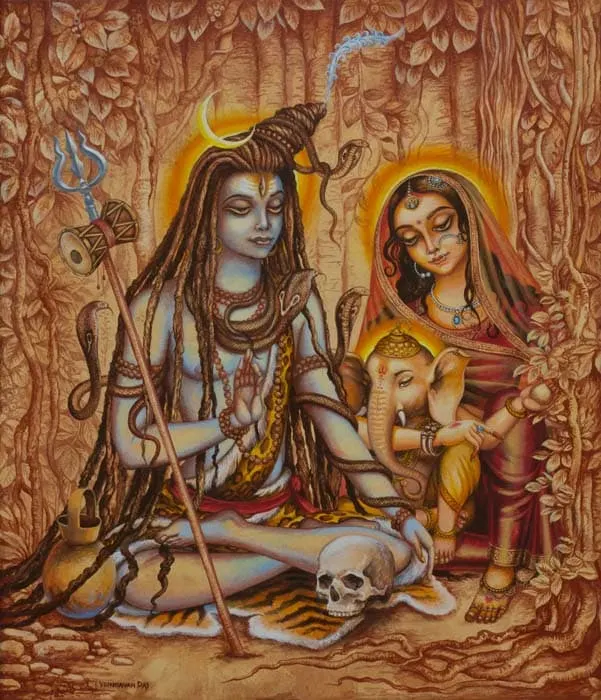
Let me tell you a story about the birth of an Indian God.
There are probably more complicated ways to make a god, but Pārvatī (the Adi shakti itself) begins with what she has on her skin.
She wants to take a bath. Śiva is away, no one is guarding the door, and somewhere between washing herself and wanting simply to be left alone, she gathers the turmeric paste from her own body and starts shaping it. The substance changes depending on which version of the story you’re reading — turmeric, sandalwood, the residue of bathing, sometimes clay — and I have always preferred the clay, even though it doesn’t belong equally to every telling. I like a creation myth with dirt under its fingernails, and dead cells on her skin.
She works the matter until it has shoulders, arms, legs, a face. Then, without waiting for anyone to fertilise anything, she gives it life. Śiva is nowhere in this. And that absence is the whole point: Pārvatī doesn’t make Ganesha through union with a masculine counterpart, because Śakti, at least in the way I want to read this story is already the power by which the One becomes many. Creation doesn’t require two human-shaped gods reproducing like two human-shaped animals. It pours out of itself. Life makes life, matter keeps inventing forms, and existence has never seemed remotely interested in staying singular.
There’s something almost indecent about how much Śakti produces. A seed splits itself open and becomes a tree; the tree flings a thousand seeds back at the world; roots crack stone; cells divide without asking permission; forests swallow ruins whole. Modesty is not a quality creation has ever bothered with.
So Pārvatī takes what belongs to her own body and makes another being out of it. And then, having just manufactured a god, she asks him to guard the bathroom door. This, honestly, is one of the reasons I love Indian mythology — the sacred keeps landing in the middle of the domestic and the absurd. She tells the boy that no one is to enter, and shortly afterward Śiva comes home to find an unfamiliar child blocking the way into his own wife’s chambers. Neither of them has ever seen the other. One believes, quite reasonably, that he has every right to pass. The other has been alive for perhaps five minutes and already possesses an absolute, uncompromising commitment to his job.
It goes badly. Śiva sends his gaṇas to remove the boy; the boy proves impossible to remove; the standoff escalates into open warfare, and eventually Śiva does what gods in Purāṇic stories occasionally resort to when communication has failed completely , he cuts off the child’s head, cruelty obviously is a necsesay part of a good storytelling.
Pārvatī is not pleased. In the Śiva Purāṇa her grief becomes a rage strong enough to threaten the cosmic order itself, and this is where the story turns genuinely beautiful to me, because the Mother who created life doesn’t become powerless the moment that life is destroyed. Creation and destruction aren’t tidy moral opposites here they belong to the same terrifying fertility. Whatever force can bring a being into existence can also tear the world apart over losing it.Mother does no compromise when it conmes to her child.
Her son has to be restored, and an elephant’s head is brought and joined to the body though I’m no longer sure “restored” is the right word for what happens. Restoration implies returning something to what it already was. Ganesha doesn’t return to what he was. He becomes something else. A human body rises up now carrying the head of an elephant, and the mythology seems entirely at peace with a creature for whom our usual categories are suddenly useless. Human, animal, child, god , you can pick whichever box you like. He’s already broken it.
I think something gets lost when we rush to domesticate the elephant into symbolism — big ears mean listening, the trunk means adaptability, the head means wisdom, fine, but before turning him into a spiritual infographic, actually look at him. Here is a god’s intelligence living inside the head of an animal whose intelligence we’ve spent centuries failing to fully understand; an animal capable of uprooting a tree and, in the same body, manipulating something delicate with the tip of its trunk; an animal we associate with memory, with social bonds, with gravity , kings, power, patience and sheer physical presence. In the elephant, strength and intelligence were never separated to begin with. Neither were sensitivity and power.
Maybe that’s why Ganesha feels so complete. He doesn’t transcend the animal to become divine. He includes it.
We’ve spent a great deal of human history congratulating ourselves for climbing out of animality, as though consciousness only became sacred once it learned to deny the body carrying it around. Ganesha offers something stranger: intelligence wearing an elephant’s face, divinity with an appetite, wisdom that has weight. The sacred, here, eats sweets, has a belly, rides a mouse, and carries an animal’s memory inside the very face through which it looks out at the world. Creation, it turns out, has no particular respect for the borders we’ve drawn inside it and it is rather indulgent :)
Which is maybe why the story couldn’t end with the human boy Pārvatī first made. His original form was only one possibility among an unimaginable number of others. Śakti creates him; destruction breaks that form apart; Śakti simply continues through another. Creation is not sentimental about its earlier shapes — it just makes the next one.
Śiva then gives him precedence among the gods. He becomes Gaṇapati, lord of the gaṇas, the one invoked at beginnings, the one we approach when we’d like the road ahead to open — which is funny, when you think about it, given that his entire divine career started by blocking a door.
We call him the remover of obstacles, but the older idea underneath that title is far more interesting: Ganesha governs vighna generally, which means he can place an obstacle just as easily as he clears one. At first that sounds like a contradiction. It stops sounding like one the moment you stop assuming the obstacle and the path are two different things. If everything belongs to creation, where exactly would an obstacle come from that wasn’t creation too?
We like sorting experience by whether or not it cooperates with us. The open road belongs to the journey; the fallen tree, apparently, doesn’t. Love belongs; heartbreak is an interruption. Health belongs; illness has somehow slipped outside the plan. The right answer belongs; confusion is wasted time. We build our itinerary and then call anything that ignores it an obstacle. But Śakti was never given an itinerary. If creation keeps on creating, the wall is made of that same creation. So is the wrong turn. So is the door that won’t open.
This is close to līlā — the divine play in which manifestation doesn’t sort itself into useful and useless the way we do. The same force that opens one road builds the mountain standing across another. The same intelligence that clears one possibility closes off a different one. Arrival and delay come from the identical source, as do form and its collapse, the creature we were and whatever we turn into once that first shape can no longer hold us. The obstacle isn’t sitting outside the play, watching. It’s playing too.
There’s something in this that human cultures have understood for a long time through initiation. Mircea Eliade wrote about rites of passage in which moving from one state of being into another requires ordeal — separation, symbolic death, some deliberate rupture in ordinary continuity. You don’t get to carry your old identity, intact, into a genuinely new state. Some gates have teeth. And Ganesha, wonderfully, is both the guardian standing at the gate and the one transformed by passing through it: made human, placed at a threshold, challenged there, beheaded there, and returned from it no longer human in the way he was before. The obstacle doesn’t just delay him. It produces him.
Which is where the story becomes more useful to me than any promise that a god somewhere will simply make my problems vanish. I think we’ve been asking Ganesha the least interesting question available. Remove this. Move that. Make the road easier. Oṃ Gaṃ Gaṇapataye Namaḥ — and yet in many Śaiva and Śākta ritual traditions, Ganesha is invoked precisely at the very beginning, before the devotee turns toward the principal deity at all. His image has historically stood at the start of temple sequences, clearing access before anything else happens. There’s something almost architectural in that before you enter, there is a threshold, and someone waiting at it.
I feel this most in sādhana specifically. Before the ferocity of Kālī, before Bhairava, before any practice capable of rearranging the comfortable furniture of the self, there’s this thoroughly grounded creature stationed near the door : the elephant, the belly, the sweets, the mouse, the broken tusk. Nothing about him is straining to escape matter; that’s the first initiation, actually: before trying to transcend the human condition, inhabit it completely. Before reaching for pure consciousness, notice that consciousness showed up here wearing an animal body, with hunger and memory and fear and strength and instinct and an unreasonable capacity to create.
And then, just to make sure none of these settles into something tidy, the Purāṇas refuse to agree on how any of it actually happened. In the Brahmavaivarta Purāṇa, the elephant head arrives through an entirely different chain of events involving Śani’s dangerous gaze. Other traditions rewrite the birth again from scratch. Even the broken tusk collects competing biographies — in one telling he sacrifices it himself while working as Vyāsa’s scribe for the Mahābhārata, in another it’s broken during his fight with Paraśurāma.
Honestly, I like the disorder, i’m a master of chaos myself. Myth turns tedious the moment we force it to behave like history. Maybe a god born out of Śakti’s infinite creativity is entitled to more than one birth. Maybe a creature who already collapses the line between human and animal should collapse the line between one version of his own story and the next. The contradictions don’t diminish him. If anything they multiply him — which, given who he is, seems fairly appropriate.
And after all that multiplying, I still find myself back at the door of Pārvatī’s bathroom. A woman wanted to take a bath. She made a child out of her own body and set him at a threshold. He guarded it so completely that the encounter cost him his first form, and out of that loss came the god who would preside over every beginning afterward. There is almost an entire spiritual path folded into that ridiculous little domestic scene.We arrive at an obstacle convinced it has interrupted our journey, when sometimes the obstacle is the only part of the journey with any power to actually change us. Not every wall is sacred, and not every difficulty has been secretly arranged by the universe for our personal growth , life is a good deal less narcissistic than that. But some thresholds genuinely cannot be crossed by whoever first arrives at them.
Ganesha arrived at his with a human head. He left with an elephant head and tasks. He comes back as Ganesha. Creation is not sentimental about its previous shapes because it opens another door into Śakti without explaining her to death or dissolution.For this reason I resist reducing the elephant head to a list of agreeable symbols about wisdom and listening. Something much stranger has happened. The human body has been opened to the animal; the child has survived his original form; creation has continued by becoming something it had never been before.
The obstacle was never asking to be removed; what about it was asking : “what else we could become in this infinite creation, with the blessings of an infinite loving Divine mother”?