When We Speak of Krishna, We Speak of Līlā
A JANMASHTAMI REFLECTION
Madalina Yoga Alliance E-RYT 500
लीला…līlā — divine play
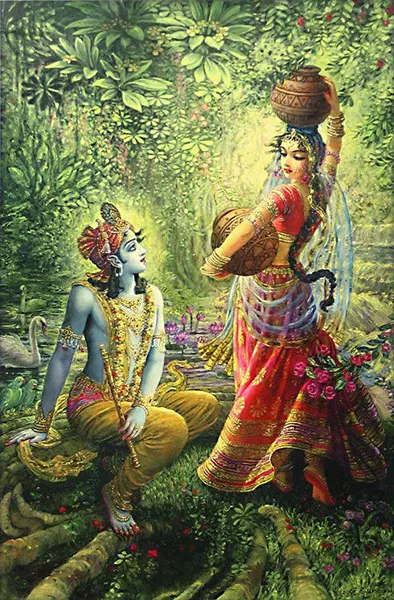
Tomorrow on the 4th of September we celebrate Janmashtami , the birth of lord Krishna. For me when we speak of Krishna, we speak of Leela. Leela is life experienced as play, as movement, as celebration. The sacred dance, the joyful cosmic game between Krishna and his beloved Radha. Leela is a blissful way we can meet with life. Instead of gripping every experience with our hands, searching for outcome and demanding to know what it means, where it is taking us, and what it will eventually give us in return, we go into action with only pure bliss, joy and innocence of a child.
Krishna has always been the Hindu deity that intrigued me the most, precisely because he refuses to be reduced to a single quality. He is the child and the lover, the prince and the strategist, the warrior and the teacher. He belongs as naturally among the cows and fields and forests of Vrindavan as he does on the battlefield of Kurukshetra, and through every one of these transformations something in Krishna stays the same. There is lightness that never collapses into simplicity, or reductivity, an intimacy with life that never asks to be imprisoned by it. Life should be lived in the moment, in the dance or sadness, buut never taken for granted or explained as it it ..as the child experience and lets go of outcome or expectations.
Ear say: I once heard Sadhguru describe leela in a way that has stayed with me since: that to truly play with life means we must be willing to play with everything life contains, not only its sweetness. Our joy, yes, but also our sorrow. Our love, but also its loss. Our most difficult emotions, and even death itself. It is easy to call a sunset or a child’s laughter līlā. It is another thing entirely to look at grief, at ending, at the parts of existence we spend our whole lives trying to avoid, and to recognize the same invitation to play hidden inside them.
The child !
Janmashtami takes us back to the beginning, and the beginning contains very little of the sweetness we later associate with the child Krishna. He arrives at midnight, in a prison, born to Devaki and Vasudeva under the shadow of Kamsa, the king who has already killed their previous children because of a profecy and intends to kill this one too. Vasudeva carries the newborn through the night and across the Yamuna toward Gokul, and this child who enters the world surrounded by fear, violence and the nearness of death will soon become remembered for something entirely different: stealing butter, teasing the gopīs, playing among the cowherds, escaping Yashoda, creating trouble, laughter and delight wherever he goes.
There is something extraordinary in this movement from the prison to the playground, because Krishna’s childhood does not deny the darkness of his birth. It simply refuses to let that darkness dictates the entire character of existence. Before Krishna becomes a philosopher, before anyone asks him about duty or action or the nature of the Self, before the enormous metaphysical vision of the Bhagavad Gita, Krishna is a child absorbed in the pleasure of being alive, already carrying, without knowing it yet, the seed of a much harder teaching: that play and danger are not opposites.
This is where leela begins to make sense to me. Not as a doctrine to be studied but as something almost bodily, something children still know before we try to tame their innocence. A child can spend an afternoon building a sandcastle, destroy it , forget about it and then build another one. When one world dies another appears. The first world was never meaningless because it disappeared. Its meaning lived entirely in the intensity with which it was inhabited and the joy that brings. Children do not mourn for long, the move on..
GOALS!!!!
We adults have become far more complicated than that. Almost everything has to lead somewhere. A relationship must become a future, a journey must transform us, a practice must improve us, a career must establish us, a spiritual path must eventually deliver some superior version of ourselves, and even our moments of joy are rarely permitted to simply exist before the mind begins calculating how to repeat them, preserve them, or prevent their disappearance. We have turned even happiness into a project with a deadline. A nonstop karmic event… action and outcome…
Leela is far more unsettling than the charming translation of “divine play” suggests, because it asks whether we are capable of being completely involved in our lives without constantly negotiating with the expectations. Treat experience as Valuable before we know where it leads. Whether love can be real without becoming possession or a commitment. Whether an action can be wholehearted without success being guaranteed. And I’ ll ask even further: whether sorrow itself can be entered the same way, fully, without our fleeing it or clinging to it as proof of how much we loved. To play with life, in this sense, is not to stay on its lit surface, is easy to be playful when is convenient for us. I can testify for that! But…. What about to bring the same quality of presence to what wounds us, so that even grief becomes something we move through rather than something that moves in and stays?
The teenager!
Then Krishna grows, and leela changes its flavor. The mischievous child becomes the young man with the flute, Vrindavan becomes the landscape of desire and devotion, and with Radha the play turns more intimate, more sensual, more dangerous, because now there is something to lose. Their story holds union but also separation, ecstasy but also longing, and this is precisely what makes it so different from our contemporary obsession with defining love through permanence…. forever..
We tend to believe that love proves itself by its longevity, that something which ends must somehow have failed, and that the person we love must eventually be absorbed into the architecture of our life in order for the experience to have been validated. Radha and Krishna, they disturb that logic completely. Their love does not become insignificant because it refuses to be domesticated into possession, ending up with the royal marriage or a cinderela story.. Separation itself becomes part of its juice, and longing is another way the beloved continues to exist within the lover, an ache that is still, somehow, a form of intimacy. But, this is also the beginning of the rasa(the emotion) of Bhakti (devotion). I completely feel that is this story heartbreak has different meaning.An it gives me this feeling of freedom: it demands to stop measuring the truth of an experience by its duration. The obsession with grabbing on our experience from eternity is another expression of fear of allowing life to move but without allowing ourselves to be moved, transpierced by life itself.
The warrior!
Krishna, meanwhile, keeps moving. The lover becomes the prince and strategist, and eventually we meet Krishna again in an entirely different landscape, standing beside Arjuna between two armies at Kurukshetra, and no possibility of pretending that choices carry no consequences, and where death itself, on the largest possible scale, stands waiting on the field.
When Arjuna collapses in front of the reality of the battle and wants to withdraw, Krishna does not offer him a spirituality of escape or a soft neutral answer. He brings him more deeply into action, while asking him to release his attachment to the outcome, and he speaks to him of the Self that is never born and never dies, that is not cut by weapons or burned by fire. It is here, more than anywhere else in his story, that Krishna teaches us to play with death itself: not by denying it , or rushing toward it, but by understanding it correctly enough that it stops being the opposite of life but a part of it.
Seen through this lens, leela and the teaching of non-attachment belong together, and together they widen into something bigger than a philosophy of joy. We can act intensely without being consumed by the result. Love deeply without converting another human being into property. Create without demanding applause. Grieve without becoming our grief. Choose without requiring the universe to reassure us endlessly that we chose correctly. We can give ourselves completely to what is happening, sorrow included, ending included, while leaving enough space for life to remain larger than our plans for it, and larger, even, than our fear of losing it. It feels like an invite to go beyond illusion or maya, see this veil of life constantly creation itself and disappearing, making the best of our life without trying to grasp.
My big conclusion: We need leela in our life in order to live a healthy happy life. We need to stay playful. This is where Krishna feels incredibly contemporary to me, because we have become so serious about ourselves. We optimize, heal, improve, regulate, analyses and reinvent ourselves until even spirituality begins to resemble an administrative project, tasks, lists of things to accomplish before we finally qualify as peaceful human beings. We have become extraordinarily sophisticated at observing life with the preciosion of a neurosurgeon, while sometimes forgetting how to participate in it. We are being pd celebration and joy. And also in the sorrow somehow there is joy contained.
Krishna offers a very different image of spiritual maturity, one in which wisdom does not require the disappearance of humor, sensuality, pleasure, contradiction, sorrow or play. The person capable of speaking the Gita is also the boy who stole butter, the lover who danced with the gopis and later lived with her absence, the friend who jokes and schemes, the strategist who understands the imperfections of the political world, the teacher unafraid to speak of death on a battlefield. There is no need to choose which of these is the “real” Krishna, because the wholeness lies precisely in his capacity to hold them all together, and to play with each without being owned by any of them.Ther is no separation in between all.
That may be the part of Krishna I love most: he does not divide existence into the spiritual and the ordinary, the sacred and the playful, the joyful and the grievous. The kitchen can contain God as easily as the temple. Desire can become devotion. Friendship can become a spiritual path. A battlefield can become the place where the nature of consciousness is revealed. A stolen handful of butter can carry as much intimacy with existence as a philosophical discourse, and a broken heart can carry as much devotion as an untouched one.
For me, this is what Janmashtami celebrates beyond the extraordinary mythology of Krishna’s birth: we can take our actions seriously without making ourselves unbearably serious. We can understand that life has consequences while refusing to live permanently terrified of them, or of their ending.
The possibility to enter fully, to participate with everything we are, to love the world without demanding ownership of it, to grieve without disappearing into grief, to face even death without turning away from the music, and to retain enough of the child within us that, in the middle of all this astonishing human seriousness, we can still recognise when the music has started, and allow ourselves to Dance… With life, with death. To become vast enough that nothing human needs to be exiled anymore. That you don’t want to be a superhuman but more like realizing being human is bloody awesome…