TRAUMA AND MOVEMENT
Creation is faithful to itself, never to its forms...
Madalina Yoga Alliance E-RYT 500
What happens when someone lets you down?
For me, the answer arrives faster than required ..
I lose a little of my faith in humanity.
Not only in the person who disappointed me, but in people themselves. The world becomes less trustworthy, slightly less welcoming. Without realizing it, I retreat into the ivory shell of solitude, convincing myself that distance is wiser than openness, that self-sufficiency is safer than connection.I choose loneliness for a while.
It is a subtle movement of the psyche.
The wound is not only the disappointment itself. The wound is the contraction that follows. Curiosity gives way to vigilance and defense mechanisms. Participation gives way to withdrawal. Life continues to move, yet something within us quietly stops flowing…stops like a scary paralyzed cat.
For a long time I believed that healing meant understanding what happened. . If I could replay every conversation, decode every contradiction, understand every silence, actions, perhaps I would finally recover my peace.
But understanding has strange limits , very blurry.
The mind is capable of explaining almost anything. It can reconstruct events with extraordinary precision. It can establish causes, distribute responsibility, justify anger, defend innocence. It can build a coherent narrative out of chaos.
And yet, a perfect explanation does not necessarily restore our capacity of rejoicing in life.
You may understand exactly why someone betrayed your trust and still wake up with a body that has forgotten how to soften.Like you slowly start noting a shell to protect the softness that was wounded.
This made me wonder whether the story and life belong to two different orders of reality, not completely opposite but strangely intertwined.
Stories organize experience. Life transforms it..or is the better picture..
Stories organize experience.
Life transforms it.
Stories preserve continuity. They tell us who we were, what happened, how one event led to another. They are indispensable for out individual self and the making sense process. Without them we would have no memory, no identity, no culture..and maybe bo sanity;).
But life seems indifferent to narrative.
Life circulates,is chaotic;
It breathes. It digests. It destroys old patterns..and specially it surprises us.
It heals broken bones without asking who was responsible.Blood does not hesitate before entering the next heartbeat.Inhale follows exhale without us doing anything.
❁
Perhaps this is why I found myself returning, almost instinctively, to traditions that have always understood existence less as a collection of things or thoughts but more like a living process as transformation.
In Kashmir Shaivism, reality is not conceived as a static creation but as Spanda--.-the subtle pulsation of consciousness itself….like a huge sound system spreading all aver. Shakti is not merely the feminine principle or a goddess among others. She is the dynamic power through which existence continually reveals, conceals, destroys, renews and recreates itself. The universe is not finished. It is happening over and over again.
The Buddha approached the same mystery from another direction. Rather than speaking of divine energy, he observed that every conditioned phenomenon is marked by Anicca--…-impermanence. Nothing possesses an independent, permanent essence. We suffer not because change exists, but because we continually negotiate with change as though permanence were possiblby We are attached..and we suffer.Perhaps these traditions are not speaking about different realities.
Perhaps they are describing the same movement through different languages.
One speaks of pulsation.
Another of impermanence.
Both refuse to imagine life as something fixed.
If this is true, then perhaps our deepest struggle is not with change but with our ideas about change.
Ideas have an extraordinary capacity to arrest movement, to capture it like U capture a butterfly.U end up breaking its wings.The moment we name something, we begin to believe we have captured it. We say, this is who I am, this is what happened, this is the kind of person he is, this relationship meant this. Gradually, experience hardens into identity. Movement crystallizes into concept….
Language is one of humanity's greatest achievements.
It is also one of its most subtle prisons.
Reality continues to unfold while our ideas remain strangely loyal to a moment that no longer exists.
Perhaps this is why Krishnamurti insisted that the word is never the thing. The description of a river is not the river. The memory of love is not love. The image I carry of another person is not the living person standing before me. Between reality and the image we construct of it, an immense distance quietly appears.
And perhaps suffering begins in that distance.In the duality of the separation.
Not because ideas are false, but because they are still.
Life is not.
❁
Every cell of the body exists through exchange. Every ecosystem through relationship. Every breath through the perpetual dialogue between inhalation and exhalation. Even consciousness is never static; perception is continuously renewed.
Death, in its deepest symbolic sense, may not be the absence of life….
It may be the refusal to participate in life's continuous becoming.
Not biological death.
But psychological immobility.
The moment we become more faithful to our conclusions than to reality itself.
Perhaps every authentic spiritual tradition is, in its own way, an invitation to die before we die--not to the world, but to the certainty that yesterday can ever contain today.
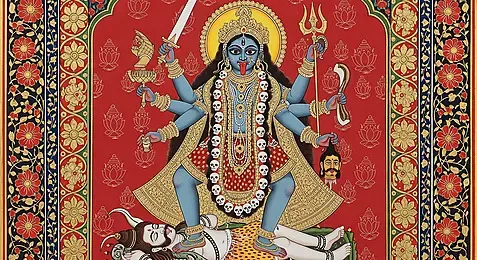
Perhaps this is why Kali has always fascinated me.The darling godess of time and death in Hindu mythology.
She is often misunderstood as the goddess of death, terrifying in her garland of skulls and her tongue stained with blood. But death, in the Tantric imagination, is not her destination. It is her instrument.
Kali is not destruction per se.. She is so much more…
Every form eventually becomes too small for the life it once contained. Every certainty hardens. Every identity begins as a revelation and ends as a prison. Kali arrives not because she hates form, but because she refuses to let life become imprisoned within it.
Perhaps this is why she stands upon Shiva in some of Hindu depicted pictures.
Pure consciousness, left untouched by movement, remains silent. It is Shakti, in her fierce aspect as Kali, who refuses that silence to become inertia. She cuts ; She severs. She dissolves. Not out of cruelty, but out of fidelity to life itself…to Truth..
Maybe this is also what psychological death looks like.
Not the death of the body, but the moment we become more devoted to our ideas than to reality. We preserve an image of ourselves long after we have changed….We preserve an image of another person long after they have disappeared or left ..We preserve old grief because it has become familiar, like a habit..We preserve certainty because uncertainty asks us to move…and scares us. KALI teaches us fearlessness.
In that sense, every attachment carries within it a quiet desire for permanence.
And permanence is something life has never promised.
Kali does not kill life.
She kills our illusion that life could ever stand still.
❁
Every ending is an act of devotion to becoming…The dance between death and life ..none is there without the other.
Every loss is also the creation of space.
Every death protects life from becoming its own museum.
Healing is not returning to who we were; Healing is shedding a skin that no longer allows life to breathe.
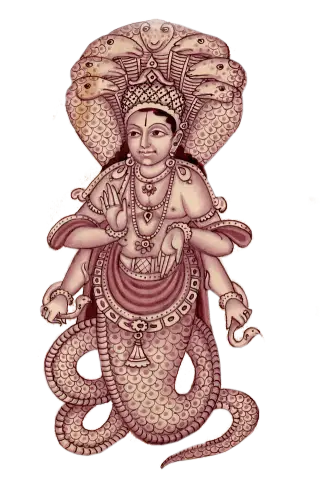
Like a snake, we do not grow by clinging to yesterday's skin. We grow because there comes a moment when what once protected us begins to suffocate us, to shrink us . The old skin is not an enemy. It simply cannot accompany the next movement of life…
Grief is part of that shedding.
And not because grief is something to overcome, but because every transformation carries its own mourning. We grieve the person we were. We grieve the future we imagined. We grieve the identities that once gave us certainty and safety.. Even liberation has its elegies.
Perhaps healing is not about becoming stronger.
Perhaps it is about becoming permeable again, opened to life.
To discover that beneath every identity, every story, every wound, something has never stopped moving…energy..
We are not separate from the river. We are the river.
We are not separate from the river.
We are the river.
We are not beings searching for movement. We are only searching for out nature…We are movement searching for ever new forms of creation.
This, perhaps, is Shakti---not merely a goddess to be worshipped, but the recognition that existence is not made of things but of ceaseless creation. We suffer when we mistake a passing form for our essence. We heal when we remember that our deepest nature was never the form itself, but the life continually expressing itself through it.
Kali smiles because she knows what we forget.
Nothing alive is meant to keep the same skin forever.
❁
Kali is not the goddess of death.
She is the death of illusion.
She appears whenever life has become imprisoned within its own forms. She cuts away certainty, identity, attachment, not because they are mistakes, but because every form eventually mistakes itself for the whole.
Creation cannot remain alive without destruction.
Not because destruction is sacred in itself, but because every living system depends upon continuous transformation. Homeostasis is never stillness. It is a dynamic equilibrium, recreated from moment to moment. The body survives because millions of cells die each second. The forest flourishes because decay nourishes the soil. Stars explode, making possible the elements from which planets and human beings are conceived. Death is not outside creation. It is one of its movements.
The ancient myths understood this.
The hindu story about churning of the Ocean of Milk in between the gods and the demons is not simply a story about gods seeking immortality. The devatas cannot obtain the nectar alone. They need the asuras, the demons.The very forces they oppose become indispensable to the emergence of amṛta. Creation advances through tension, friction and participation. Without the opposing force, there is no churning. Without churning, there is no transformation.
Goethe gives Mephistopheles the same role. He introduces himself as the spirit that forever negates, yet his negation becomes part of creation itself. He opposes, provokes and unsettles, but in doing so he becomes an unwilling servant of becoming. Even the adversary has a place within the architecture of life…
The fallen angel carries the same paradox. The descent is not outside the story of creation. It becomes one of the conditions through which freedom, responsibility and consciousness emerge. The shadow is not an accident added to existence. It belongs to the drama of becoming.
Suffering enters this movement in the same way. It is not something to worship. It is not something to seek.But it is a part of the cosmic dance ..
And neither is it meaningless.
It churns.
It exposes every illusion that can no longer sustain life. It breaks the identities that have become too narrow for consciousness. It forces questions that comfort never wants to asks.
Kali smiles because she knows that life has never been trying to preserve its forms…she is the ultimate mother that teaches harsh lessons to her kids.
Death and birth are not opponents.
They are partners in the same leela..pr dance.
Every ending is the rhythm that allows creation to begin again. That myth says something astonishing: creation reaches its highest expression not by eliminating conflict, but by transforming it.
My feelings are that every time I resist to change suffering comes as a teacher of letting go.There is beauty in the storms we pass and lessons to be learned. BE FEARLESS!